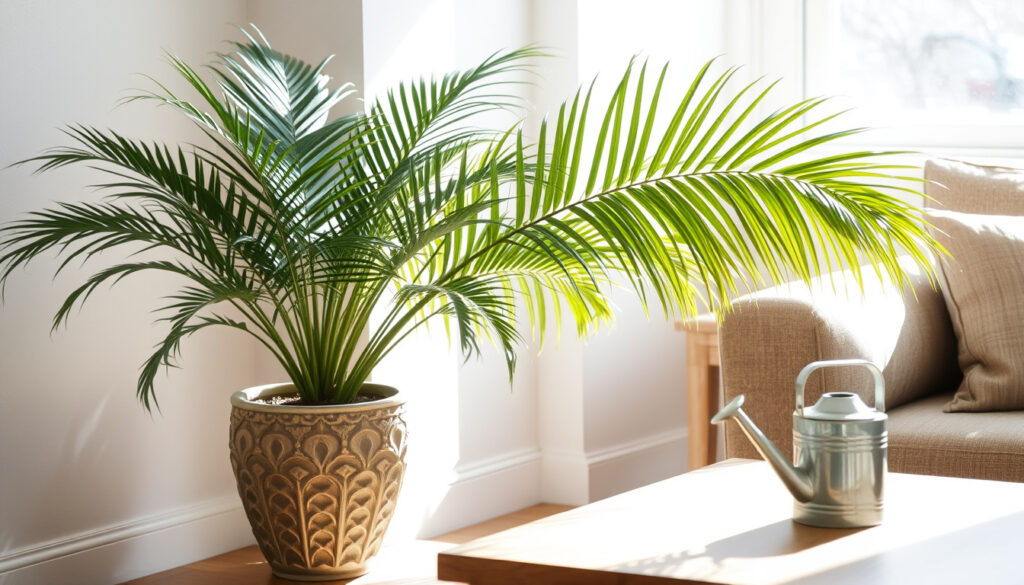
Kentia Palm Care: Watering, Light & Common Problems
You’ve just brought home a Kentia palm — stately, elegant, and a bit intimidating. But keeping its feathery fronds lush doesn’t require a green thumb; it just requires understanding its natural rhythm. This guide walks through the practical care steps that prevent the three most common failures: overwatering, dry air, and spider mites, so your Howea forsteriana can thrive for years indoors.
Native region: Lord Howe Island, Australia · Mature height (indoor): 3–6 m (10–20 ft) · Light requirement: Bright, indirect light · Common name variants: Thatch palm, Palm court palm · Min temperature tolerance: 5°C (41°F)
Quick snapshot
- Allow top 2–3 cm of soil to dry between watering (Gardeners’ World)
- Prefers bright, indirect light; direct sun causes leaf burn (Royal Horticultural Society)
- Non-toxic to pets and humans (Bloom & Wild)
- Slow grower: takes years to reach 1.5 m; new fronds emerge only 3–4 times per year (Simply Trees)
- Focus on humidity management to prevent spider mite outbreaks during winter heating season (Grow Tropicals)
Seven key specs define the Kentia palm’s identity as a houseplant. Notice the slow growth rate — that’s not a flaw but a feature for anyone who doesn’t want a palm hitting the ceiling in two years.
| Attribute | Value |
|---|---|
| Botanical name | Howea forsteriana |
| Family | Arecaceae |
| Native to | Lord Howe Island, Australia |
| Mature height (indoor) | 3–6 m (10–20 ft) |
| Growth rate | Slow |
| Toxicity | Non-toxic to pets and humans |
| Common pests | Spider mites, scale, mealybugs |
How do you care for a Kentia Palm?
Watering requirements: how often and how much
- Water when the top 2–3 cm (1 inch) of soil feels dry — typically every 7–14 days depending on season (Gardeners’ World).
- In spring and summer, water every 7–10 days; in winter reduce to every 14–21 days (Gardenia).
- Never let the pot sit in standing water — root rot is a quick killer (Bloombox Club).
Yellow leaves often mean overwatering; brown tips point to underwatering or low humidity. The rhythm is simple: check the top inch, then decide.
Light: bright indirect vs. direct sun
- Place 1–2 metres from an east- or north-facing window (Royal Horticultural Society).
- Direct afternoon sun scorches leaves, causing yellow or brown patches (Gardenia).
- Can survive in low light, but growth slows and fronds darken (Healthy Houseplants).
Low light is survivable but not optimal: the palm will stay alive, but it won’t produce new fronds with the same vigour. For a full-looking plant, give it that bright indirect spot.
Humidity and temperature preferences
- Target 50–60% relative humidity — use a humidifier or pebble tray if your home drops below 40% (Guide to Houseplants).
- Mist the leaves a few times a week, especially in winter when heating dries the air (Gardeners’ World).
- Keep away from radiators, air-con vents, and cold draughts; ideal temperature 18–24°C, minimum 10°C (Healthy Houseplants).
The implication: dry winter air is the biggest enemy — it directly triggers spider mite infestations.
Soil type and repotting schedule
- Use a well-draining potting mix with perlite or sand added for aeration (Gardeners’ World).
- Repot every 2–3 years in spring, moving up one pot size at a time (Bloom & Wild).
- Fertilise monthly from spring through summer with half-strength balanced houseplant fertiliser (Gardenia).
Do Kentia palms like sun or shade?
Ideal light conditions: bright, indirect light
Bright, indirect light is the sweet spot — think the dappled light of a forest understory. A north- or east-facing window provides this without the intensity of direct southern exposure (Royal Horticultural Society).
Signs of too much light (leaf scorch)
Yellow or brown patches that appear on the side facing the window are classic scorch marks. If you see them, pull the plant back a metre or filter the light with a sheer curtain (Gardenia).
Tolerance to low-light areas
It can survive in a dim corner — that’s one reason it’s popular for office lobbies — but growth becomes extremely slow and leaves may turn a deeper, darker green. It won’t die, but it won’t thrive either (Healthy Houseplants).
If you place a Kentia palm in a low-light spot, water even less frequently — the soil stays moist much longer, raising the risk of overwatering.
Is Kentia Palm a good indoor plant?
Air-purifying qualities
The NASA Clean Air Study identified several palms, including Howea species, as effective at removing indoor air pollutants like formaldehyde and benzene (Gardeners’ World).
Pet toxicity: non-toxic to cats and dogs
It’s listed as non-toxic by the ASPCA, making it safe for homes with curious pets (Bloom & Wild).
Maintenance level: moderate
It demands more attention than a snake plant but less than a fiddle-leaf fig. The main tasks: water on a schedule, maintain humidity, and inspect for pests monthly.
Longevity as a houseplant
With consistent care, a Kentia palm can live for decades — owners routinely report 15–20 year old specimens (though exact lifespan data remains anecdotal).
The pattern: It’s a solid choice for a statement plant that asks for moderate commitment and rewards you with years of slow, graceful growth.
What are the disadvantages of Kentia palms?
Four drawbacks matter for any buyer, especially in the Irish climate where indoor humidity can be low.
- Slow growth rate — It takes years to reach 2 m, so if you want instant impact, you pay for a mature specimen (Simply Trees).
- Susceptibility to spider mites and scale — Dry indoor air is the main trigger; a spider mite outbreak can damage fronds quickly (Grow Tropicals).
- Cost of large specimens — A 150 cm plant in Ireland typically costs €50–150 from specialist nurseries.
- Leaf browning from dry air or tap water — Fluoride and chlorine in municipal water cause tip burn; using filtered or rainwater helps (House Beautiful UK).
The catch: The same traits that make it a low-maintenance plant — slow growth and adaptability — also mean it doesn’t bounce back quickly from mistakes. Overwater once badly, and recovery takes months.
Upsides
- Elegant, arching fronds that fill a room
- Non-toxic to pets
- Tolerates low light better than most palms
- Long lifespan with basic care
Downsides
- Slow growth — patience required
- Prone to spider mites in dry air
- Expensive in large sizes
- Brown tips from tap water or low humidity
Where is the best place to put a Kentia palm?
Lighting for indoor placement
One to two metres from an east- or north-facing window is ideal. That distance provides the bright, indirect light the palm evolved under on Lord Howe Island (Royal Horticultural Society).
Avoiding drafts and heat sources
Keep it away from air conditioning vents, radiators, and cold draughts from doors or windows. These cause leaf edges to crisp up (Gardeners’ World).
Corner vs. near window
A bright corner works, but avoid deep, dark spots. Rotate the plant every month so all sides receive equal light and the growth stays symmetrical (Bloom & Wild).
Your living room’s north-facing alcove is the Kentia’s sweet spot — it gets consistent indirect light, stays out of drafts, and acts as a natural humidity buffer. No need to move it around.
How often do I water a Kentia palm?
Watering frequency by season
- Spring/summer (growing season): every 7–10 days (Gardeners’ World).
- Winter: every 14–21 days — keep the soil just moist, not wet (Gardenia).
Signs of underwatering vs. overwatering
Yellow leaves point to overwatering; brown, crispy leaf tips indicate underwatering. Check the top 2–3 cm of soil before reaching for the watering can (Bloom & Wild).
Best watering technique (bottom watering)
Water until excess drains out the bottom, then discard the run-off. Bottom watering (placing the pot in a tray of water for 30 minutes) encourages deep root growth, but never leave the pot standing in water (Bloombox Club).
What this means: consistency trumps volume. A gentle, predictable schedule beats a big drench after weeks of neglect.
What are common Kentia palm problems?
Yellow leaves: causes and fixes
Overwatering is the usual culprit. Let the soil dry out more between waterings. If root rot has set in, repot into fresh, dry mix and trim any mushy roots (Gardeners’ World).
Brown leaf tips: causes and treatment
Low humidity, fluoride in tap water, or salt buildup from fertiliser cause tip browning. Use filtered or rainwater, flush the soil quarterly, and increase humidity around the plant (Healthy Houseplants).
Pests: spider mites, scale, mealybugs
Spider mites are the most frequent pest, thriving in dry air. Increase humidity, wash the leaves with a gentle stream of water, or treat with insecticidal soap or neem oil (Grow Tropicals). Scale and mealybugs can be removed with a cotton swab dipped in rubbing alcohol.
Fungal issues and root rot
Waterlogged soil breeds root rot. Prevention is the only reliable cure: use well-draining soil, allow the top layer to dry, and never let the pot sit in a saucer of water (Bloombox Club).
Step-by-step seasonal care routine
- Spring (March–May): Start monthly fertilising, increase watering frequency, and repot if root-bound. Check for winter pest damage and wipe leaves clean.
- Summer (June–August): Water every 7–10 days, mist regularly, and rotate the plant. Protect from direct sun through south-facing windows.
- Autumn (September–November): Reduce fertilising to once every other month, gradually space out watering, and move the plant away from drafty windows as temperatures drop.
- Winter (December–February): Water sparingly (every 14–21 days), stop fertilising, and run a humidifier if indoor humidity falls below 40%. Inspect for spider mites weekly.
The implication: the winter months are the highest-risk period for Kentia palm health in Ireland — heating dries the air and owners tend to overwater out of habit.
backyardboss.net, bloomboxclub.com, reddit.com, palmtalk.org
For those seeking a thorough understanding of Kentia palm maintenance, the detailed Kentia palm care guide offers practical advice on watering and light.
Frequently asked questions
Can a Kentia palm survive in a bathroom?
Yes, as long as there’s a window for natural light. Bathrooms usually have higher humidity, which the palm loves, but low light can slow growth significantly.
Why is my Kentia palm turning yellow?
Most often overwatering. Let the top 2–3 cm of soil dry out before watering again. Also check that your pot has drainage holes and the plant isn’t sitting in water.
How do I propagate a Kentia palm?
Propagation is difficult at home because the palm doesn’t produce offshoots. It’s typically grown from seed, which can take months to germinate and years to reach a saleable size.
Does a Kentia palm need fertilizer?
Yes, but lightly. Use a balanced liquid houseplant fertiliser at half strength once a month during spring and summer. Do not fertilise in winter.
Is the Kentia palm toxic to dogs?
No, it’s non-toxic to dogs, cats, and humans according to the ASPCA. The palm is safe even if your pet nibbles on a leaf.
How fast does a Kentia palm grow?
Slowly — typically 15–30 cm per year indoors under optimal conditions. It can reach 3 m over many years, but patience is required.
What is the difference between Kentia palm and Areca palm?
Kentia (Howea forsteriana) has darker, more arching fronds and tolerates lower light better. Areca (Dypsis lutescens) grows faster, needs more light, and has lighter green, upright fronds.
Related reading
- Kiwi Fruit: Benefits, Daily Intake, and Comparisons
- Shower Niche Guide: Pros, Cons, Alternatives & Design Tips
More related posts
 Bindi Irwin’s Endometriosis, Family, and Conservation Legacy
 Romy Mars: The Nepo Baby, Family, Career, and Key Facts
 Rachel Maddow: Biography, Surgery, and Show Changes
 Jenna Ortega: Biography, Career, and Personal Life Facts
 Andrew Bogut: NBA Career, Stats, Net Worth, and Current Activities
 2025 Kia Carnival: Price, Specs, Hybrid, and Review
 Porsche Cayenne Price – New and Used in Australia
