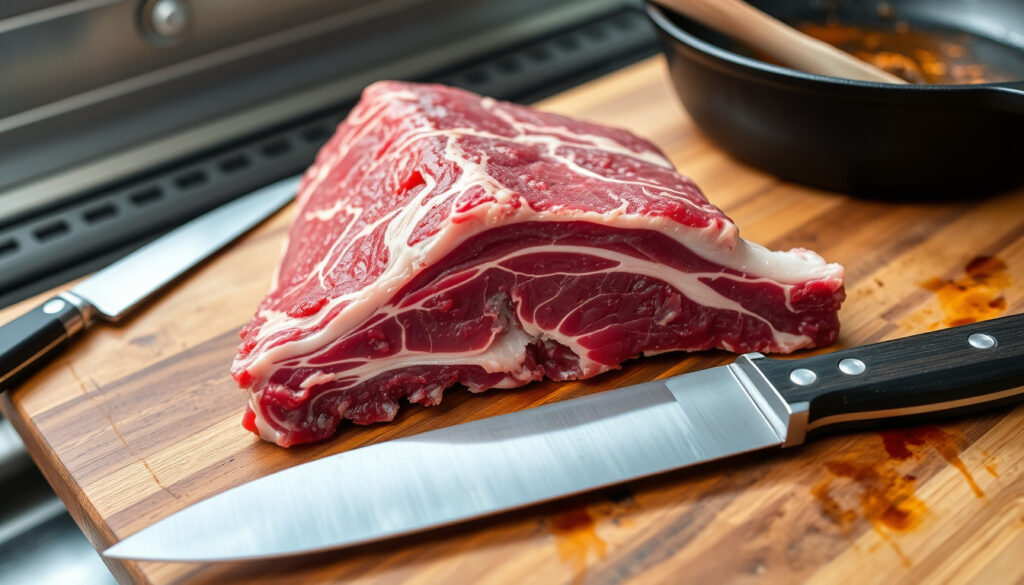
Beef Short Ribs Guide: Cooking Methods, Cuts & Mistakes
If you’ve ever stood in the meat aisle wondering whether those chunky bone-in rectangles are worth the price, you’re not alone. This guide covers cut identification, cooking methods, and common mistakes to help you master beef short ribs.
Average cooking time (braised): 2–3 hours ·
Target internal temperature: 203°F (95°C) ·
Typical price per pound: $8–$12 ·
Most popular cooking method: Braising ·
Alternative cut name: Jacob’s Ladder
Quick snapshot
- Beef short ribs are cut from the chuck or plate primal (Acabonac Farms (meat purveyor))
- Braising is the most recommended method for tenderness (Snake River Farms (ranch-to-table supplier))
- Oven braising at 275–300°F takes 2.5–3 hours (Snake River Farms)
- Whether Aldi always stocks beef short ribs (varies by region) (Aldi UK (grocery retailer))
- Exact naming conventions in all parts of Ireland (Bord Bia (Irish Food Board))
- Whether grilling is better than braising for certain cut types (Acabonac Farms)
- Collagen breakdown into gelatin during slow cooking – though widely stated, exact temperature thresholds vary by source (Acabonac Farms)
- Oven braise (300°F): 2.5–3 hours (Snake River Farms)
- Slow cooker low: 6–8 hours (Tastes Better From Scratch)
- Pressure cooker (Instant Pot): 45 min + 15 min natural release (Tastes Better From Scratch)
- Smoking (225°F): 4–5 hours to 190–200°F internal (Snake River Farms)
- Demand for premium cuts is rising in home cooking (USDA (government agriculture data))
- More retailers expected to carry backyard BBQ cuts (Costco (warehouse retailer))
- Recipe developers pushing flavor variations beyond traditional beef broth (RecipeTin Eats (recipe site))
Six key facts, one pattern: short ribs reward patience. The best results come from long, slow cooking that transforms tough connective tissue into luxurious gelatin.
| Attribute | Details |
|---|---|
| Cut name | Beef short ribs (Jacob’s ladder) |
| Primal location | Chuck or plate |
| Best cooking method | Braising (low and slow) |
| Average weight per piece | 1–2 pounds (bone-in) |
| Common uses | Braised dishes, BBQ, Korean cuisine |
| Alternative name (Ireland) | Short beef ribs or Jacob’s ladder |
What is the best way to cook beef short rib?
Braising: the classic method
- Sear ribs in a hot pan with oil until deeply browned on all sides.
- Deglaze the pan with red wine, scraping up browned bits.
- Add aromatics (onion, garlic, thyme) and enough beef stock to reach halfway up the ribs.
- Cover and transfer to a 275–300°F oven; cook for 2.5–3 hours until fork-tender (internal 203°F).
- Braising is the most recommended technique for tenderness because low and slow cooking breaks down connective tissue (Snake River Farms (ranch-to-table supplier)).
- Cook time: 2–3 hours at 275–300°F for fall-apart texture (Snake River Farms).
- Target internal temperature: 203°F (95°C) for gelatin rendering (Acabonac Farms (meat purveyor)).
Before braising, sear the ribs in a hot pan with oil until deeply browned on all sides (Tastes Better From Scratch (recipe site)). Deglaze the pan with red wine, scraping up the browned bits (Tastes Better From Scratch). Add aromatics (onion, garlic, thyme) and enough beef stock to reach halfway up the ribs. Cover and transfer to the oven.
The implication: braising isn’t set-and-forget — the sear and deglaze build layers of flavor that a slow, moist environment then deepens. Skip either step and you lose complexity.
Home cooks who want restaurant-style results should start with braising — it’s the most forgiving method with the highest success rate. For barbecue enthusiasts, smoking at 225°F adds a smoky dimension that a braising liquid cannot match.
The pattern: for most home cooks, starting with braising minimizes risk and maximizes reward.
Slow cooker short ribs
- After searing and deglazing, cook on low for 6–8 hours (Tastes Better From Scratch).
- No need to add extra liquid beyond the deglaze — slow cookers retain moisture (RecipeTin Eats (recipe developer)).
Slow cookers are forgiving but lack the high heat of oven braising for caramelization. The trade-off: convenience over depth.
Oven-baked short ribs
- For BBQ-style ribs, bake at 275°F for 3.5–4 hours covered tightly with foil (Eat Simple Food (recipe blog)).
- Uncover for the last 20 minutes to let the glaze set.
Why this matters: oven baking at lower temperatures mimics braising but allows a dry rub or spice paste to form a bark. Great for gatherings where you want both tenderness and crust.
Grilling and smoking options
- Smoking at 225°F takes 4–5 hours to an internal temperature of 190–200°F (Snake River Farms).
- Flanken-cut short ribs (cross-cut thin slices) are ideal for quick grilling over high heat — popular in Korean BBQ (Acabonac Farms).
Grilling flanken ribs takes minutes; smoking whole English-style ribs takes hours. The catch: choosing the wrong cut for your heat source will either overcook (thick ribs on high heat) or underdevelop (thin slices in low smoke).
What are common mistakes when cooking short ribs?
Not searing the meat first
- Searing develops flavor through the Maillard reaction (Snake River Farms).
- Many recipes from professional chefs emphasize that the fond (browned bits) is the backbone of the sauce (Michelin Star Beef Short Ribs YouTube (chef demonstration)).
Skipping the sear is the most widespread mistake. Without it, the finished dish tastes flat.
Undercooking or cooking too quickly
- Short ribs need prolonged cooking at low heat to become tender. High heat causes the meat to toughen and the collagen to seize (Acabonac Farms).
- Reportedly, some home cooks rush by setting the oven above 350°F, which results in dry, stringy meat.
The pattern: low heat + long time = tender; high heat + short time = shoe leather.
Skipping the resting period
- Resting allows juices to redistribute. Cutting immediately after cooking causes the meat to dry out (Snake River Farms).
- For braised short ribs, let them rest in the liquid for 10–15 minutes off the heat before serving.
Using the wrong cut
- Flanken cut requires a different cooking approach than English cut. Using flanken for braising will yield overcooked, falling-apart slices because they are thin (Acabonac Farms).
- English cut (thick, bone-in) is best for braising; flanken is best for grilling or Korean galbi.
The catch: buying short ribs without knowing the cut type leads to frustration. Ask your butcher for the intended cooking method.
Butchers report that “over-trimming the fat cap” is another common error — the fat protects the meat during long cooking and adds flavor. Leave a ¼-inch layer intact (Snake River Farms).
The bottom line: avoiding these mistakes gives you a head start on tender, flavorful short ribs.
How long should I put short ribs in the oven?
Oven temperature: 300°F–325°F
- At 300°F, bone-in short ribs take 2.5–3 hours for braising (Snake River Farms).
- At 325°F, target 2.5 hours (Acabonac Farms).
Timing for bone-in vs boneless
- Bone-in cuts take slightly longer (up to 30 minutes extra) because the bone conducts heat differently (Snake River Farms).
- Boneless short ribs cook faster but are less flavorful (Acabonac Farms).
Covered vs uncovered cooking
- For braising: cook covered (with a lid or foil) to retain moisture (Cast Iron Skillet Cooking (recipe source)).
- For BBQ-style ribs: cover for the first 3 hours, then uncover for 20 minutes to thicken the glaze.
Testing for doneness
- Meat should be fork-tender — a probe meets no resistance (Snake River Farms).
- Internal temperature of 203°F is the benchmark for fall-apart texture.
The bottom line: set your oven to 300°F, cover, and check at 2.5 hours. If the meat resists, go another 30 minutes. Bone-in pieces are forgiving; boneless need a watchful eye.
Is short rib a good cut of beef?
Flavor profile and marbling
- Short ribs come from the beef chuck or plate primal, areas with heavy marbling (Acabonac Farms).
- High fat content makes them rich, beefy, and flavorful — often compared to brisket or chuck roast.
Comparison to other beef cuts
- Short ribs have more connective tissue than ribeye or sirloin, which means they need longer cooking but reward with superior gelatin content.
- Unlike brisket, short ribs are sold in smaller portions, making them manageable for home cooks.
Best uses for short ribs
- Ideal for slow cooking methods: braising, slow cooker, pressure cooker, and smoking.
- Korean galbi jjim (braised short ribs) is a classic example of their potential (RecipeTin Eats (recipe site)).
Nutritional considerations
- Contains significant collagen that breaks down into gelatin during cooking — beneficial for joint health.
- A 3.5 oz serving of braised short ribs (lean only) provides roughly 25g protein and 20g fat (USDA FoodData Central (government nutrition database)).
What this means: short ribs are not a weekly staple for calorie counters, but as an occasional indulgence they deliver unmatched depth of flavor. If you’re cooking for a special dinner or a cold weekend, they are the cut to choose.
Is Jacob’s ladder the same as a short rib?
Anatomy of a short rib
- Jacob’s ladder is a specific cut of beef short ribs from the plate primal, where the bones resemble ladder rungs (Acabonac Farms).
- English-style short ribs are cut parallel to the bone into 3-4 inch thick pieces. Flanken-style are cross-cut thin slices (Acabonac Farms).
Why it’s called Jacob’s ladder
- The name comes from the biblical ladder in Jacob’s dream — the parallel bones resemble a ladder (Acabonac Farms).
Regional naming differences (Ireland, UK)
- In Ireland, beef short ribs are commonly called “short beef ribs” or “Jacob’s ladder” (Bord Bia (Irish Food Board)).
- In the UK, the term “Jacob’s ladder” is widely used by butchers for bone-in short ribs.
How to identify the cut at the butcher
- Bone-in: look for parallel bones with meat between them, about 3-4 inches long.
- Ask for “English cut short ribs” for braising, “flanken cut” for grilling (Snake River Farms).
The trade-off: paying for “Jacob’s ladder” may be pure marketing — any bone-in short rib from the plate is essentially the same product. Focus on marbling and fat cap thickness rather than the name.
A buyer who knows that “Jacob’s ladder” is simply a branded term for bone-in short ribs can avoid paying a premium. Local butchers often sell the same cut under a generic label at half the price.
The catch: knowing the cut’s anatomy helps you shop smarter and cook more effectively.
“Braising is the most forgiving way to cook short ribs. You can’t rush it — you need patience.”
— Acabonac Farms (meat purveyor)
“The key to Michelin-style short ribs is reducing the red wine until it’s syrupy before you add the stock. That concentrated flavor makes the sauce.”
— Michelin Star Beef Short Ribs YouTube (chef demonstration)
“Slow cooker short ribs are perfect for busy weeknights. You sear, deglaze, set the timer, and come back to a meal that tastes like you stood over the stove.”
— RecipeTin Eats (recipe developer)
Beef short ribs are a cut that demands respect — and a low oven. For the home cook who wants a crowd-pleasing dish that feels special, braising at 300°F for three hours delivers consistently. The choice is clear: invest the time, or settle for dry, tough meat. For the cook who cannot commit to three hours, a slow cooker buys convenience at the cost of some flavor depth. But for anyone who loves deep beefy flavor, there is no shortcut that beats a well-braised short rib.
Related reading: How to Cook Beef Short Ribs · What is Short Rib
Frequently asked questions
Can you grill beef short ribs?
Yes, but only flanken-cut (thin cross-cut) ribs work for direct grilling. English-cut ribs require indirect heat or smoking at low temperature to become tender (Acabonac Farms).
What is the difference between short ribs and spare ribs?
Short ribs come from beef (chuck or plate); spare ribs come from pork. They have different fat content, cooking times, and flavor profiles (USDA).
Should I remove the membrane from short ribs?
Not necessary for braising; the membrane dissolves during long cooking. For grilling flanken ribs, it can be removed to allow marinade penetration.
Do I need to sear short ribs before braising?
Yes — searing develops the Maillard reaction, which adds deep savory flavor. It is a step most chefs insist on (Snake River Farms).
Can I cook short ribs in a pressure cooker?
Yes. In an Instant Pot, cook at high pressure for 45 minutes with a 15-minute natural release (Tastes Better From Scratch).
How to reheat leftover short ribs?
Reheat gently in the braising liquid on the stovetop over low heat, or in a 300°F oven covered for 15–20 minutes. Avoid microwaving, which toughens the meat.
What is the best wine for braising short ribs?
A dry red wine like Cabernet Sauvignon, Merlot, or Pinot Noir works well. Avoid sweet wines. Reduce by half before adding to the pot (Michelin Star Beef Short Ribs YouTube).
How long are cooked short ribs good in the fridge?
Cooked short ribs last 3–4 days in an airtight container. Alternatively, freeze in the braising liquid for up to 3 months (USDA food safety guidelines).
More related posts
 Christie Brinkley: Skin Cancer, Billy Joel, and Children
 Bunnings Seven Hills – Opening Hours and Store Guide
 Abby Bergman: Age, Career, and Life After The InBESTigators
 Method Man Biography: Real Name, Net Worth, Biggest Hit & More
 Orlando Bloom: His Life, Dyslexia Journey, and Relationships
 Catherine O’Hara Cause of Death: Pulmonary Embolism Truth
 AFL Live Scores and Stats – Where to Find Real-Time Updates
 Best&Less Near Me: Store Locations, Hours & Sales Guide
