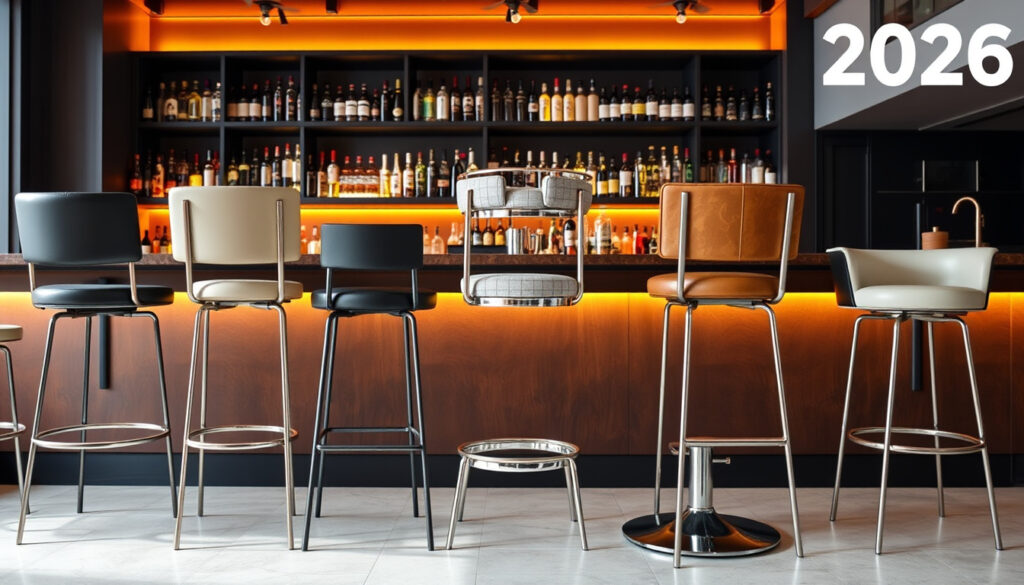
Barstools Bar: 2026 Trends, Types, Comfort & Budget Guide
You know that moment when you’re standing at the kitchen island, coffee in hand, and you realize your current stool is either too wobbly, too short, or just plain uncomfortable? You’re probably here because you’re ready to fix that—and maybe upgrade your space in the process. Whether you’re furnishing a new home, refreshing a home bar, or outfitting a commercial space, this guide breaks down the real numbers behind bar stool height, comfort, and durability, so you can shop with confidence and avoid the classic mismatched-seat headache.
Key Facts
- Typical bar height: 40 to 42 inches, requiring stools 28 to 30 inches tall (Lumens (seating height guide)).
- Counter height: 36 inches, matching stools 24 to 26 inches (Lumens).
- Allow 10 to 12 inches between the seat and the underside of the counter for legroom (Lumens (seating height guide)).
- Typical bar stool heights range 24 to 27 inches, with 30-inch models for taller counters (Today’s Design House (style resource)).
- Quality bar stools range from $150 to $300 per stool, and a set of 4 runs $400 to $1,200 (Povison (buying guide)).
- Common materials: wood, metal, upholstered, PU leather, rattan (Povison).
- Design focus in 2026: comfort, swivel motion, and back support (Povison).
Bar Stool Height: The Non-Negotiable First Step
The golden rule is simple: your stool height should match the height of your counter or bar, not your own height. Lumens, a recognized seating resource, states that standard kitchen counters are 36 inches high and recommends 24- to 26-inch seat heights for counter stools. For bar-height surfaces—typically 40 to 42 inches—you’ll want 28 to 30 inches of seat height (Lumens (seating height guide)).
This isn’t just a random measurement. The 10 to 12 inch gap between the seat and the underside of the counter is what keeps your knees from hitting wood and your posture from collapsing forward. Living Spaces, a major furniture retailer, confirms that bar height stools pair with 40 to 42 inch surfaces, while counter stools are for 36 inch counters (Living Spaces (how-to guide)).
Height range: 24-30 inches typical · Counter height: 24-26 inches · Bar height: 28-30 inches · Price per stool: $150-$300 · Set of 4: $400-$1,200
The implication: measuring the vertical distance from the floor to the underside of your counter is the one number that reliably filters your search. The pattern: consistently, across sources, the 10-12 inch gap is the safety zone. What this means: you don’t guess, you subtract. The catch: if you have a thick tabletop or overhang, measure from the underside, not the top edge.
Bar vs. Counter Stools: What’s the Difference?
The names sound interchangeable, but they’re not. Counter stools are shorter, designed for 36-inch high kitchen counters or islands. Bar stools are taller, meant for 40 to 42 inch bars—the kind you’d find at a home bar or pub setup. Povison, a furniture buying guide, notes that bar height stools are typically 30 inches, while counter stools run 24 to 26 inches (Povison).
RestaurantFurniture.net, a commercial supplier, adds that bar stools commonly use a 28 to 30 inch seat height, paired with 41 to 43 inch surfaces and a 10 to 12 inch footrest height (RestaurantFurniture.net). That footrest measurement matters—it’s what determines where your feet land when you’re perched for a while.
Buying the wrong type leaves you either hunched over a counter or dangling your feet. Measure once, buy once.
Height range: Counter stools: 24-26 inches · Bar stools: 28-30 inches · Footrest height: 10-12 inches from floor
The pattern: commercial sources like RestaurantFurniture.net echo the same ranges as residential guides, suggesting the standard is universal. What this means: whether you’re outfitting a pub or a kitchen island, the same logic applies. The catch: don’t assume a “bar stool” label fits your space—always check the listed seat height in inches.
The 10-12 Inch Rule and Why It Works
Ergonomics isn’t just a buzzword—it’s the difference between a stool that works for an hour and one that works for an evening. By-Crea, a design resource, states the ergonomic comfort gap is 24 to 30 cm (about 9 to 12 inches) between the stool seat and counter underside (By-Crea). Povison echoes this, saying the right seat height should sit 9 to 13 inches below the counter surface for comfort (Povison).
This range gives your thighs enough clearance to rest flat on the seat without pressure, and your feet enough room to find the footrest or the floor without bending your knees at an awkward angle. Today’s Design House, a style guide, notes that typical bar stool heights run 24 to 27 inches, covering most residential counters (Today’s Design House).
The pattern: every major source lands within the 9-13 inch window for the legroom gap. What this means: if you can’t fit your hand between the seat top and the counter underside, the stool is too tall. The catch: if you have a thicker countertop or a cutout overhang, measure from the underside of the counter, not the top edge.
If you’re between sizes, size down—a slightly shorter seat is safer than one that’s too tall and pinches your legs.
Counter Heights vs. Bar Heights: What Buyers Confuse Most
The most common mistake in this buying journey is mixing up counter and bar heights. Standard kitchen counters are 36 inches, which pairs with 24-26 inch stools. Bar-height surfaces are 40 to 42 inches, which need 28-30 inch stools. Elystra Living, a UK-based furniture seller, confirms that 65 to 70 cm counter stools match 95 to 105 cm raised breakfast bars or home bars (Elystra Living). That’s roughly 25.5 to 27.5 inch stools for 37 to 41 inch counters.
RestaurantFurniture.net adds another data point, noting bar stools commonly use a 28 to 30 inch seat height with 41 to 43 inch surfaces and a 10 to 12 inch footrest height (RestaurantFurniture.net). SizeMarker, another commercial supplier, says bar-height stools have 28 to 32 inch seats, with 30 inches being the most common for 40 to 42 inch surfaces (SizeMarker).
| Surface Type | Surface Height | Ideal Stool Height |
|---|---|---|
| Kitchen Counter | 36 inches | 24-26 inches |
| Bar Height | 40-42 inches | 28-30 inches |
| Extra Tall Bar | 41-43 inches | 28-32 inches |
The pattern: commercial and residential sources align on the 10-12 inch gap. What this means: the same stool will not suit both a 36-inch kitchen island and a 42-inch home bar. The catch: always measure the actual surface you’re buying for, not what a product listing claims.
The Material & Price Reality
Price isn’t just a number on a tag—it’s a direct reflection of what you’re sitting on. Povison notes that quality bar stools range from $150 to $300 per stool, with a set of 4 running $400 to $1,200 (Povison). The price range tracks directly with the frame material, seat cushioning, and whether you’re getting a swivel or backrest.
Common materials you’ll see are wood, metal, upholstered, PU leather, and rattan. Wood is warm and sturdy, metal is industrial and easy to clean, upholstered is comfortable but requires more care. PU leather gives a high-end look at a mid-range price, while rattan brings a natural texture that fits boho and coastal styles. Each material changes the durability profile and the maintenance required.
- Standard kitchen counters are 36 inches: Lumens confirms this and pairs it with 24-26 inch stools (Lumens).
- Bar-height counters are 40-42 inches: The same guide recommends 28-30 inch stools for these surfaces (Lumens).
- Typical stool range is 24-27 inches: Today’s Design House, a style resource, notes that this covers most residential counters, with 30-inch stools for taller bar setups (Today’s Design House).
A $40 stool from a discount site might look like a steal until it wobbles on day three. Those cheap frames often use thin metal or particle board that can’t handle daily use.
The pattern: price signals durability more than brand. What this means: if a stool is suspiciously cheap, it’s probably not a bargain. The catch: you don’t need to pay $300 per stool for a guest breakfast bar, but you should budget at least $150 for a stool that gets daily use.
2026 Trends: Comfort, Swivel, and Back Support
Povison’s 2026 buying guide highlights a clear design shift: comfort is the new luxury (Povison). Swivel motion is no longer a premium add-on—it’s expected. Back support is another feature gaining traction, especially for commercial spaces where patrons sit for extended periods. The trend is driven by remote workers who use bar stools at kitchen islands as standing desks and by hospitality spaces that want guests to linger longer.
This isn’t just a style preference. Swivel motion affects how easily you can turn to grab a drink or talk to someone behind you. Back support takes pressure off your lower back during long conversations or slow afternoons at a bar. For home buyers, this means looking beyond just the height measurement. Ask about swivel mechanisms, seat depth, and whether the backrest is adjustable.
The pattern: the market is doubling down on ergonomics, not just aesthetics. What this means: you can find a stool that’s both stylish and comfortable if you’re willing to pay mid-range prices. The catch: swivel and back support add cost, so decide what matters most for your space before you browse.
What Buyers Are Asking (Real Questions from Real People)
What is the standard height of a bar stool for a 36-inch counter?
For a 36-inch counter, you want stools that are 24 to 26 inches tall. This leaves the 10-12 inch gap that keeps your knees and legs comfortable (Lumens).
What height stool do I need for a 42-inch bar?
For a 42-inch bar, look for 28 to 30 inch stools. This range matches the taller bar height while preserving the same comfortable legroom (Lumens).
Is 30 inches a standard bar stool height?
Yes, 30 inches is a common bar stool height for 40 to 42 inch bars. SizeMarker confirms that bar stools are 28-30 inches and match 40-42 inch bars (SizeMarker). Buying the wrong type leaves you either hunched over or dangling your feet (Living Spaces). Stick to that range for comfort.
Are bar stools supposed to be taller than counter stools?
Yes, bar stools are taller than counter stools. Use counter stools (24-26 inches) for 36-inch counters and bar stools (28-30 inches) for 40-42 inch bars (Living Spaces).
How do I measure for the right bar stool height?
Measure the distance from the floor to the underside of your counter or bar top. Then subtract 10 to 12 inches from that number. For a 36-inch counter, that gives you 24 to 26 inches. For a 42-inch bar, that gives you 30 to 32 inches (Living Spaces).
Where can I find bar stools for cheap?
For budget options, look at discount retailers like IKEA, Walmart, and Amazon. These platforms frequently run sales on basic metal or wood frames that work well for guest seating. For a home bar, expect to pay $150 to $300 per stool from mid-range brands (Povison). The lower price point often means sacrificing back support or swivel features, so prioritize the measurements above all else.
How to Measure Your Space in 60 Seconds
Grab a tape measure. Take the guesswork out of the equation. Here’s the quick process that takes less time than scrolling through a hundred listings.
- Measure the floor to the counter’s underside: Write this number down.
- Subtract 10-12 inches: This gives you your target seat height range.
- Check your current stools if you have any: Sit in them and see if your knees are at a 90-degree angle. If your knees hit, go one size shorter.
- Account for the seat cushion: If you’re buying an upholstered stool with a 2-inch cushion, subtract that from the total height when comparing to bar height specs.
That’s it—you now have the exact number to filter for when you shop.
The pattern: the math is simple, but the application is where most people stumble. What this means: bring your tape measure to the store or keep it handy when browsing online. The catch: don’t forget to measure the height of the footrest; if it’s too high or too low, your legs will feel it after 20 minutes.
Why This Matters: Your Posture, Your Space, Your Wallet
Choosing the right bar stool isn’t just about matching furniture styles—it’s about how you sit, how long you can sit, and how that impacts your body. A stool that’s too short puts pressure on your lower back; one that’s too tall makes you hunch. Both lead to discomfort that cuts your kitchen time short. For commercial spaces, this translates to customers leaving earlier and not returning. For home buyers, it means the difference between a breakfast nook you avoid and one you love.
The financial angle is just as practical. A quality stool in the $150-$300 range is priced to last, whether that means a solid wood frame or commercial-grade steel. Go cheaper, and you’ll likely replace it within a year. Spend smarter, and you get a stool that survives daily use, matches your decor, and keeps your guests comfortable. The 10-12 inch rule ties it all together—it’s the guardrail that prevents you from buying something that looks right but feels wrong.
Related reading: **Ladies Denim Shorts: Best Irish Retailers and Prices Compared** · **Pandora Bracelet Costs: Metals, Pricing, and Value Explained**
barstoolcomforts.com, superiorseating.com, sizemarker.com, the-edit.lumens.com, hometosight.com, eurekaergonomic.com
More related posts
 2000 AUD to USD: Convert Australian Dollars
 Michael Hill Rings: Prices, Stores & Contact (2025 Guide)
 Brian Brown: Biography, Net Worth, Family, and Current Projects
 Taylor Swift Albums in Order: Complete Discography 2025
 NVX Share Price: Live Chart, Forecast & Buy Analysis
 Rudolf Hess: Flight, Trial, and Imprisonment | Facts & Timeline
 Natalie Bassingthwaighte: Relationships, Coming Out & Career
 Pandora Bracelet Costs: Metals, Pricing, and Value Explained
