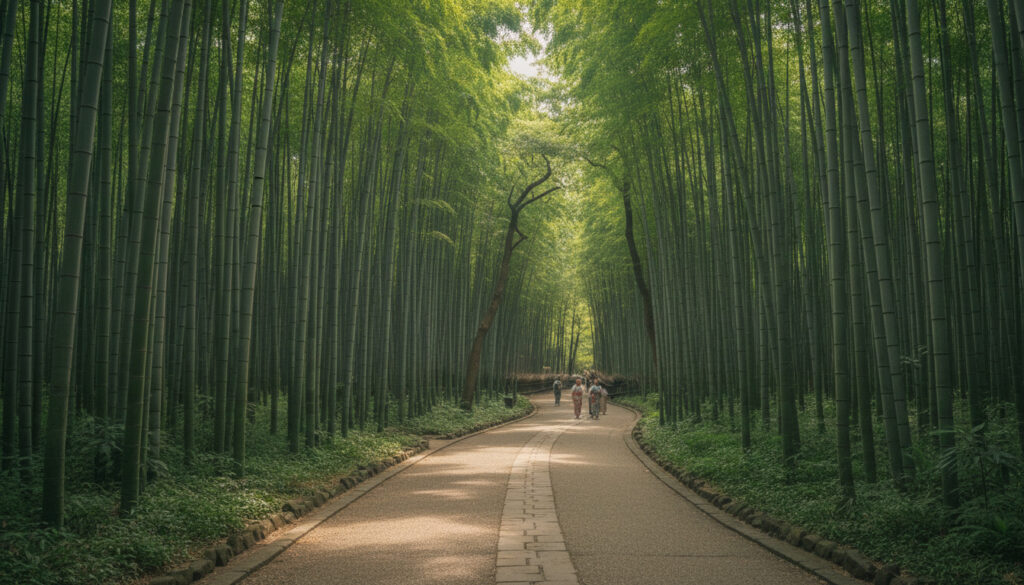
Arashiyama Bamboo Grove – Best Times, Access, Tips
The Arashiyama Bamboo Grove rises from the western outskirts of Kyoto as a corridor of towering green stalks that filter sunlight into shifting patterns across a narrow public walkway. This compact 100 to 200-meter path draws millions of visitors annually who seek the hushed atmosphere that has made the district iconic, yet remains accessible as a free, open-air public space operating without gates or entrance fees. Located in the historic Arashiyama district, the grove functions as both a standalone attraction and a natural gateway to deeper cultural exploration of western Kyoto.
Reaching the grove from central Kyoto requires a brief train journey followed by a short walk through traditional streets. The JR Sagano Line connects Kyoto Station to Saga-Arashiyama Station in approximately 15 minutes for 240 JPY, after which visitors walk roughly 10 minutes northward to the path entrance near Tenryu-ji Temple. This accessibility has cemented the location as a staple of Kyoto itineraries, though the experience varies dramatically depending on arrival time and seasonal factors.
Unlike managed tourist attractions with controlled entry, the bamboo path operates as a public thoroughfare that remains open continuously. This unregulated status creates both opportunities for solitary early morning visits and challenges during peak tourism hours when the narrow walkway becomes congested with tour groups and photographers.
Where Is Arashiyama Bamboo Grove and How to Get There?
- Sunrise to 8:00 AM offers the most serene experience with cooler temperatures and ethereal light
- The JR Sagano Line runs frequently from approximately 5:00 AM, though exact 2025 timetables require verification via transit apps
- Weekday visits reduce congestion compared to weekends and school holidays
- Rainfall amplifies the atmospheric quality as bamboo stalks sway and rustle, though wet paths require caution
| Attribute | Details |
|---|---|
| Transport from Kyoto Station | JR Sagano Line to Saga-Arashiyama (15 mins, 240 JPY) |
| Walking Distance from Station | 10 minutes north to grove entrance |
| Path Duration | 5–10 minutes end-to-end at normal pace |
| Operating Hours | No restrictions; daylight recommended for safety |
| Accessibility | Paved but uneven; challenging for wheelchairs |
| Nearby Transit | Keifuku Arashiyama Station (Randen line) |
The physical approach to the grove sets the tone for the visit. Visitors arriving via Saga-Arashiyama Station traverse residential streets and the approach to Tenryu-ji Temple before reaching the northern entrance where bamboo thickets suddenly enclose the path. Arashiyama’s status as a historic villa district during the Heian Period means the approach itself traverses centuries of layered development, though the current footpath represents modern routing through groves planted and maintained over generations.
What Is the Best Time to Visit Arashiyama Bamboo Grove?
The Early Morning Advantage
Timing determines whether visitors experience the grove’s intended serenity or its notorious congestion. The window from sunrise until approximately 7:30 or 8:00 AM provides optimal conditions: temperatures remain cool even during summer months, horizontal light pierces the canopy creating photographic opportunities, and foot traffic consists primarily of local joggers and dedicated photographers. Sources indicate that this pre-8:00 AM period often allows visitors to walk the entire length without encountering tour groups.
Navigating Peak Congestion
By 9:00 AM, arrivals begin accelerating, with density peaking between 10:00 AM and 3:00 PM. Travel guides note that this midday window coincides with tour bus schedules and independent travelers arriving from central Kyoto. Late afternoon visits after 4:00 PM can reduce crowds, though diminishing light quality and dropping temperatures diminish the experience, particularly during winter months.
Midway along the path, gaps in the canopy create natural spotlights when morning sun angles through. Visitor reports suggest positioning yourself at these light patches just after sunrise yields images unobstructed by the crowds that arrive after 9:00 AM.
Seasonal Variations
Spring cherry blossom season and autumn foliage periods exacerbate congestion throughout Arashiyama, not merely at the bamboo path itself. School trip seasons and Japanese public holidays create additional surges. Traveler data confirms that weekday visits outside these peak seasons offer the highest probability of uncrowded passage.
Arashiyama Bamboo Grove Hours, Fees, and Path Length
24-Hour Accessibility
No ticket booths or gates restrict entry to the bamboo path, which functions as a public walkway connecting the Tenryu-ji Temple area toward Saga-Arashiyama Station. Official guidance confirms the path remains technically accessible at any hour, though safety concerns regarding dim lighting and uneven surfaces make daytime visits advisable. Visitors should not expect illumination after sunset.
Understanding the Compact Dimensions
Photographic perspectives often exaggerate the grove’s scale. The primary photographed section constitutes a straight 100 to 200 meter stretch that requires only 5 to 10 minutes to traverse at a normal walking pace. Recent visitor reviews emphasize that first-time guests frequently underestimate how quickly they reach the end. Quieter extensions exist beyond the main thoroughfare for those willing to explore deeper into the surrounding residential and temple areas.
The Brevity Factor
The compact nature of the attraction means most visitors combine the bamboo path with other Arashiyama activities rather than treating it as a standalone destination. The short duration necessitates minimal physical preparation, though comfortable footwear remains essential given the unpaved and occasionally root-lifted surface.
Is Arashiyama Bamboo Grove Worth Visiting?
Photography Strategy
The visual impact of towering bamboo creates compelling imagery when conditions cooperate. Successful photography requires managing expectations about crowds and understanding that the famous corridor effect requires specific angles and patience. Those seeking people-free compositions must arrive during the first hour of daylight or accept considerable editing work during peak hours.
Nearby Attractions
The grove’s value increases significantly when integrated into a broader Arashiyama itinerary. Tenryu-ji Temple sits adjacent to the entrance, offering formal garden spaces that complement the natural bamboo setting. TripAdvisor reviews recommend visiting the temple immediately after the bamboo path to maintain momentum before 10:00 AM crowds arrive.
Iwatayama Monkey Park requires a short hike uphill from the grove’s vicinity, rewarding visitors with panoramic views of Kyoto and populations of wild Japanese macaques. The contrast between the manicured bamboo path and the rugged monkey park trail provides distinct experiences within walking distance. Some travelers extend their day to include Nijo-jo Castle, though this requires additional transit time.
Expect to share the path with hundreds of other visitors during standard hours. Tourism analysis indicates that overtourism pressures have persisted into 2025, with no specific visitor caps implemented. The experience may feel anticlimactic when viewed as a standalone attraction during crowded periods.
While paved, the path surface features uneven sections and root intrusions that challenge wheelchair users and those with mobility limitations. Accessibility reports note no lifts or modified access points exist, making early morning visits potentially more navigable simply due to reduced foot traffic allowing slower passage.
When evaluating whether the grove warrants inclusion in a limited Kyoto schedule, consider your tolerance for crowds and your ability to arrive before 8:00 AM. The spectacle of towering bamboo holds genuine aesthetic power, but that power diminishes rapidly when shared with dense tour groups. Travelers who enjoy My Neighbour Totoro often find the grove reminiscent of Studio Ghibli’s forest aesthetics, while those planning extensive walking might prioritize footwear like the Asics GT 1000 12 for the surrounding temple circuits.
How Has Arashiyama Bamboo Grove Developed Over Time?
-
Arashiyama emerges as a villa district during the Heian Period, with aristocrats constructing retreats that established the area’s association with natural beauty and seasonal contemplation.
-
Bamboo planting intensifies in the district, though specific cultivation dates for the current grove remain historically undocumented. The plants establish themselves as part of the managed landscape surrounding temple complexes.
-
The grove transitions from local landmark to national tourist destination during Japan’s post-war tourism development, with photography circulating in travel media that amplifies its visual distinctiveness.
-
Tenryu-ji Temple and surrounding Arashiyama landscapes receive recognition as part of Kyoto’s UNESCO World Heritage designation, indirectly elevating the bamboo path’s international profile though the grove itself holds no independent UNESCO status.
-
Post-pandemic travel surges return overtourism pressures to the district, with visitor volumes sustaining high levels that impact local residential quality and path maintenance.
What Information Is Definitive Versus Uncertain?
Established Facts
- Zero entrance fee for the bamboo path
- 24-hour public access without gates
- 100–200 meter main path length
- JR Sagano Line fare of 240 JPY from Kyoto Station
- 10-minute walk from Saga-Arashiyama Station
- Adjacent to Tenryu-ji Temple
Variable or Unclear Information
- Exact daily crowd levels fluctuate based on weather and tour schedules
- Specific planting dates and bamboo species documentation remain sparse
- Future visitor capacity limits or reservation systems have not been announced
- Detailed accessibility modifications remain unscheduled
- 2025-specific fare increases on JR lines require real-time verification
What Is the Historical Context of Arashiyama Bamboo Grove?
The bamboo stalks lining the path represent centuries of managed cultivation rather than wild growth. During the Heian Period, when Kyoto served as Japan’s imperial capital, Arashiyama functioned as a retreat for aristocrats seeking respite from court politics. These elites constructed villas where bamboo served both practical and aesthetic purposes, creating the foundation for the current landscape. The connection to Tenryu-ji Temple, established in the 14th century, solidified the area’s spiritual dimension, with bamboo groves traditionally symbolizing resilience and flexibility in Japanese culture.
While the grove itself lacks specific UNESCO designation, it exists within the Historic Monuments of Ancient Kyoto World Heritage Site boundaries. This contextual status recognizes the integrated relationship between natural and built environments that characterizes traditional Japanese landscape design. The current path likely follows routes that have accommodated foot traffic for generations, though the precise historical alignment may differ from the present photographic hotspots.
Modern tourism has transformed the grove from a local amenity into an internationally recognized symbol of Kyoto, appearing in countless films, advertisements, and social media posts that drive visitation. This recognition creates tension between preservation and access, as the physical plantings require specific root space and drainage conditions that heavy foot traffic potentially compromises.
What Do Travelers and Guides Report About Arashiyama Bamboo Grove?
“The difference between 6:30 AM and 9:00 AM is the difference between a spiritual experience and a queue. If you cannot commit to the early arrival, manage expectations accordingly.”
— TripAdvisor user review, 2024
“The path is shorter than Instagram suggests, but the sensory impact of the sound and light filtering through the canopy justifies the transit time from central Kyoto.”
— Japan Travel Guide analysis
“Accessibility remains challenging despite the paved surface. The narrow width and surface irregularities make wheelchair navigation difficult during crowded periods.”
— Tourism accessibility assessment
Final Assessment: Is Arashiyama Bamboo Grove Worth Your Time?
The Arashiyama Bamboo Grove delivers a visually striking experience that justifies its reputation when approached with realistic timing expectations. Visitors capable of arriving before 8:00 AM gain access to a genuinely atmospheric natural corridor that serves as an effective entry point to the broader Arashiyama district including Tenryu-ji Temple and the Monkey Park. Those constrained to midday visits should anticipate a congested, abbreviated walk that may underwhelm given the transit investment required. For travelers prioritizing My Neighbour Totoro-style natural immersion or seeking photographic opportunities, the early morning grove offers irreplaceable moments; for those seeking extensive hiking or solitude without the dawn departure, other Kyoto attractions may provide better value.
Commonly Asked Questions About Arashiyama Bamboo Grove
What weather conditions work best for visiting the bamboo grove?
Clear mornings provide optimal lighting for photography, while light rain enhances the auditory experience of rustling bamboo and creates misty atmospheric effects. Summer heat makes early arrival essential for comfort. Check forecasts before departing, as the path offers minimal shelter.
How old are the bamboo groves in Arashiyama?
Specific planting dates remain historically unclear, though bamboo cultivation in the Arashiyama district dates to at least the 14th century. Current stalks represent continuous replanting and natural propagation cycles rather than original growth from the Heian Period.
Can wheelchairs navigate the bamboo path?
While technically paved, the path features uneven surfaces, root intrusions, and narrow sections that create difficulties for standard wheelchairs. No accessibility lifts or modified routes exist. Early morning visits reduce crowd pressure, allowing slower navigation.
Is the bamboo grove illuminated at night?
No artificial lighting illuminates the path after sunset. While technically accessible 24 hours, darkness creates safety hazards due to uneven surfaces and limited visibility. Daylight visits between sunrise and sunset remain the recommended window.
How much time should I budget for the visit?
The path itself requires 10–15 minutes at minimum. A comprehensive Arashiyama morning including the bamboo grove, Tenryu-ji Temple, and the Monkey Park demands 3–4 hours. Arrive by 7:00 AM to complete the grove before crowds peak at 10:00 AM.
Are there food or restroom facilities inside the grove?
No facilities exist within the bamboo path itself. Convenience stores and restaurants operate in the surrounding Arashiyama district near the station and temple approaches. Plan accordingly before entering the walkway.
Can I bring a stroller or pushchair?
Strollers fit physically but encounter difficulty with the uneven paving and root-lifted surfaces. Carrier backpacks may prove more practical for infants. The narrow width during crowded periods complicates stroller maneuverability.
Is photography permitted throughout the grove?
Photography is unrestricted, though tripods may obstruct the narrow path during busy periods. Drone usage is prohibited. The best lighting occurs during the first hour after sunrise when sunbeams penetrate the canopy.
More related posts
 What Is Biscoff – Cookies, Spread, Origin Explained
 Niki Enhypen: Age, Height, Voice Controversy, and Biography
 Shaun Hamilton Funerals – Compassionate Funeral Services
 Ewan McGregor: Divorce, Affair, Sobriety, and Family
 Birds of Tokyo: Biography, Hits, and Name Origin Explained
 Roger Climpson: What Happened to the Legendary News Anchor
 Barstools Bar: 2026 Trends, Types, Comfort & Budget Guide
