Willow Tree Ireland: Native Species, Growth Rate & Uses
If you’ve ever walked a damp Irish field in early spring, you’ve likely spotted the fuzzy silver catkins of a willow before any other tree shows green. These fast-growing trees have been woven into Ireland’s landscape and folklore for centuries, yet most people only know the dramatic weeping willow from parks. This guide cuts through the myth to help you decide which willow belongs in your garden — and which one could cost you a foundation repair.
Native species in Ireland: At least 12 ·
Average growth rate: 3 to 6 feet per year ·
Irish name: Sail or Saille ·
Average lifespan: 30 to 60 years ·
Global species count: Over 350
Quick snapshot
- Willow bark contains salicin, the natural precursor to aspirin (Trees for Life (conservation charity))
- Several Salix species are native to Ireland (University College Cork (botany research))
- Goat willow can reach 2 metres in its first year after planting (Teagasc (Irish agriculture authority))
- Exact lifespan varies heavily with microclimate — a willow in a dry garden may live much shorter than one beside a stream. (SouthernWatch (Irish gardening analysis))
- The etymology of the Irish word ‘Saille’ is debated among linguists (SouthernWatch (Irish gardening analysis))
- Goat willow: reaches 10 metres in 10–15 years (SouthernWatch (Irish gardening data))
- Coppiced willow: final harvest height of about 8 metres after several cycles (Teagasc (Irish agriculture authority))
- Watermark disease (Brenneria salicis) has reached the UK but not yet been recorded in Ireland — worth monitoring for grey willow growers (University College Cork (plant pathology))
| Feature | Native Irish Willows | Weeping Willow (Non-Native) | Hedge/Osier Willows |
|---|---|---|---|
| Climate resilience | Excellent for Irish conditions | Good but needs damp soil | Excellent in wet lowlands |
| Root system | Manageable with species choice | Invasive — risk to pipes and foundations | Moderate, suitable for boundary planting |
| Biodiversity support | High — supports native insects and birds | Low — non-native, limited wildlife value | Moderate — provides shelter and nesting |
| Maintenance needs | Low (coppicing optional) | High (pruning, cleanup, storm damage) | Moderate (annual coppicing for material) |
| Best use in garden | Specimen, hedge, biodiversity | Large park or waterside only | Screen, windbreak, basketry material |
What is special about a willow tree?
Willows occupy a category of their own among temperate trees. They are among the fastest-growing species in cool climates, capable of adding up to 2 metres in a single year under ideal conditions. But speed alone isn’t what makes them remarkable — it’s what they’ve given us.
Symbolism of willow trees
In Celtic tradition, the willow was deeply tied to the moon, water, and feminine energy. The Order of Bards, Ovates & Druids (Celtic spiritual authority) notes that the willow month (April 15–May 12) was considered a time of intuition and emotional depth. The tree’s association with mourning and lost love — especially for the weeping willow — is a much later Romantic-era addition, not an ancient one.
The willow pattern on blue-and-white ceramics, famously produced by Wikipedia (general reference), tells a fictional Chinese love story that has nothing to do with the tree’s original folklore. Yet the symbol persists across cultures.
Medicinal uses of willow bark
Willow bark contains salicin, a compound that the human body metabolises into salicylic acid — the natural precursor to aspirin. Ancient Greek physicians recorded using willow bark for pain relief, and the modern pharmaceutical industry owes a debt to this discovery. Trees for Life (conservation charity) notes that the bark can be steeped as a tea, though modern medicine has largely replaced it with synthesised aspirin due to dosing consistency.
Willow’s medicinal legacy is genuine, but self-treating with bark tea is risky — dosage varies by species, season, and individual tree. Stick to pharmacy aspirin for reliable relief.
The implication: willow’s speed and chemistry make it a uniquely useful tree, but the romantic image has sometimes overshadowed the practical considerations an Irish homeowner needs.
Is willow native to Ireland?
Yes — and the answer matters more than you might think for garden planning. Native species adapt to local soil, pests, and rainfall in ways that imported ornamentals cannot match.
What is the Irish name for the willow tree?
The Irish word for willow is sail (pronounced “sahl”) or saille (pronounced “sahl-yeh”). It appears in Irish place names like Sailearnán and in the Ogham alphabet where the fifth letter, Saille, represents the willow.
The Tree Council of Ireland (national tree authority) lists at least 12 willow species that are native or naturalised in Ireland. Among the most common are Salix cinerea (grey willow or rusty willow), Salix caprea (goat willow or pussy willow), Salix pentandra (bay willow), and Salix aurita (eared willow).
Do willow trees grow well in Ireland?
They thrive. Ireland’s consistently damp climate and mild winters are ideal for willow growth. Irish Examiner (Irish news outlet) reports that willows are an important part of Ireland’s biodiversity, and Teagasc (Irish agriculture authority) research shows that coppiced willow plantations in Ireland can produce a harvest height of 8 metres in a standard rotation. Goat willow in particular is a pioneer species that rapidly colonises open ground, especially damp areas.
Choosing a native Irish willow means less watering, fewer pest problems, and genuine support for local insect and bird populations. For the Irish gardener, native species are the lower-risk option.
The pattern: native willows grow fast with almost no intervention — but that speed comes with responsibility. A 2-metre first-year shoot is impressive, but in year five it’s a 5-metre tree that needs space.
How quickly does a willow tree grow?
Willows are the sprinters of the tree world. Where an oak might add 30 cm in a year, a willow can add ten times that in the same season.
How fast does a weeping willow grow?
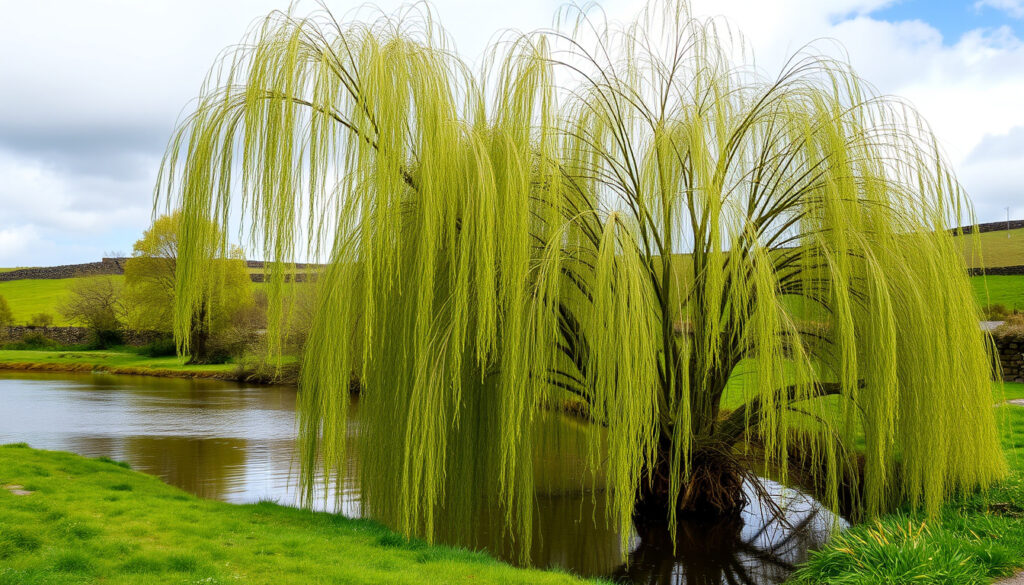
The weeping willow (Salix babylonica) is not native to Ireland — it originates from China — but it can grow 60–90 cm per year under ideal conditions, according to the Royal Horticultural Society (UK gardening authority). It reaches a mature height of 50–75 feet within 15–20 years. But that speed comes at a cost: the tree requires a constant supply of water, and its roots spread aggressively to find it.
How tall do willows get?
Height depends on species. Goat willow can exceed 10 metres (32 feet) in 10–15 years, according to SouthernWatch (Irish gardening analysis). Grey willow grows more modestly at 0.5–1 metre per year and tops out around 6–8 metres. Bay willow can reach 15 metres in ideal riverbank conditions. Irish Examiner (Irish news outlet) notes that if left unchecked, willows can reach 10 metres in height within a decade.
The catch: a fast-growing tree is also a fast-aging tree. That speed means weaker wood and a shorter lifespan than slower competitors.
What are the downsides of having a willow tree?
Willows come with trade-offs that every Irish gardener should weigh before digging a hole. The two biggest issues are roots and fragility.
Should I plant a weeping willow tree?
Only if you have a very large garden with a permanent water source and no underground pipes. The Royal Horticultural Society (UK gardening authority) advises placing weeping willows at least 20 metres from any building to avoid root damage. The roots are known to invade drains, pipes, and foundations — BuzzLayer (gardening analysis) reports they can even damage underground cables.
What are the disadvantages of a weeping willow tree?
- Brittle wood: The tree drops branches easily in storms, creating a hazard and constant cleanup duty.
- Heavy litter: Leaves, twigs, and catkins cover the ground year-round. SouthernWatch (Irish gardening analysis) cites heavy litter as one of the top five complaints from willow owners.
- Short lifespan: A weeping willow lives 30–50 years — compared with 150+ years for oak or ash.
- High water demand: If the soil dries out, the tree suffers and sends roots even further afield looking for moisture.
Upsides
- Extremely fast growth for quick shade or screening
- Stunning drooping form — unmatched ornamental value
- Excellent for riverside erosion control
- Easy to propagate from cuttings
Downsides
- Invasive roots that damage pipes and foundations
- Brittle wood — storm damage risk
- Heavy year-round leaf and twig litter
- Short 30–50 year lifespan
- Susceptible to willow sawfly and willow scab
What this means: a weeping willow is a spectacular tree for a park or a very large rural property. For a standard Irish suburban garden, it is a mistake waiting to happen.
What is the superstition about willow trees?
The willow carries a complex emotional weight in folklore — part sacred, part sorrowful, part protective. Understanding it helps explain why the tree evokes such strong reactions.
How many years does a willow tree live?
Willows live 30–60 years on average, which is short for a tree. SouthernWatch (Irish gardening analysis) puts the weeping willow at 30–50 years, while BuzzLayer (gardening analysis) confirms this range. Compare that with an oak (500+ years) or a yew (1,000+ years), and the willow’s pace of life becomes clear: burn bright, burn brief.
Why are willow trees associated with sadness?
The weeping willow’s drooping branches evoke a figure in mourning. This association was popularised in Victorian England and Romantic poetry, but it has older roots. In Irish folklore, the willow was a tree of the Otherworld — associated with the moon, feminine energy, and intuition. The Order of Bards, Ovates & Druids (Celtic spiritual authority) explains that the willow was not originally a tree of sadness, but of emotional depth and poetic inspiration. The sadness came later, layered on by literature.
The phrase ‘willow pattern’ comes from a 19th-century English ceramic design that tells a fictional Chinese love story — nothing to do with the tree itself, but it cemented the romantic-sad association in Western minds.
The willow is simultaneously a symbol of emotional depth (Celtic tradition) and a symbol of sorrow (Victorian literature). For the Irish gardener, neither needs to define your choice — the tree’s actual performance matters more than its symbolism.
The trade-off: if folklore matters to you, a native Irish willow (goat or grey) carries the authentic cultural connection without the structural headaches of the weeping variety.
What are the main uses of willow trees?
Willow is one of the most versatile trees in existence. Its uses range from practical farm materials to sentimental gifts.
Willow tree uses in gardening and hedging
Willow makes an excellent shelter belt for Irish farms and gardens. Its fast growth provides wind protection for more delicate plants. The Royal Horticultural Society (UK gardening authority) recommends osier willow (Salix viminalis) for hedging and screening. Coppiced willow produces straight rods ideal for basket making, hurdles, and furniture — wicker furniture is almost entirely made from willow.
In Ireland, willow has been used for centuries to make baskets, lobster pots, and even thatching spars. The tradition of willow weaving is alive in craft communities across the island.
Willow tree flower and catkin significance
The familiar ‘pussy willow’ catkins appear in early spring before the leaves, making them an important early food source for bees and other pollinators. The Tree Council of Ireland (national tree authority) highlights willow’s role in supporting native biodiversity — the catkins provide pollen when few other plants are flowering.
Willow figurines — small carvings of children or animals — have become a popular sentimental gift range, particularly the work of sculptors like those at Willow Tree (a brand unrelated to the tree itself).
For the Irish farmer or gardener, willow’s best use is as a quick-growing windbreak, a biodiversity booster, or a source of basketry material. For the sentimental buyer, the willow figurine market exists independently of horticulture.
The implication: willow’s versatility is genuine, but most Irish homeowners will get the most value from a native willow hedge or a carefully placed goat willow — not a weeping specimen that demands constant management.
Related reading: Kentia Palm Care Guide · Kiwi Fruit: Benefits, Daily Intake, and Comparisons
deepreport.uk, treearena.com, prospluscons.com, youtube.com, magill.ie, treepursuits.com
For a deeper look at the native willow species in Ireland, including their growth rates and folklore, see native willow species in Ireland.
Frequently asked questions
Can willow trees cause structural damage to houses?
Yes. Willow roots are aggressive and can invade drains, pipes, and foundations. The Royal Horticultural Society (UK gardening authority) recommends planting willow at least 20 metres from buildings. BuzzLayer (gardening analysis) warns that roots can damage underground cables and foundations.
Is a willow tree the same as an osier?
Not exactly. An osier is a specific type of willow (Salix viminalis and related varieties) grown for its long, straight shoots used in basketry. All osiers are willows, but not all willows are osiers. Osier willows are typically coppiced annually.
What is pussy willow?
Pussy willow is a common name for the catkins (flower clusters) of certain willow species, especially goat willow (Salix caprea). The soft, silvery catkins appear in early spring before the leaves and resemble tiny cat paws. Trees for Life (conservation charity) notes they are an important early food source for bees.
How much does a willow tree cost in Ireland?
Whips (young willow cuttings) can cost as little as €2–€5 each from nurseries. Larger container-grown specimens range from €15–€40 depending on size and species. Weeping willow trees in 15-litre pots typically cost €30–€60. Native species are usually cheaper than imported ornamentals.
Do willow trees grow in shade?
Willows prefer full sun but tolerate partial shade. However, growth rates slow significantly in low light — a shaded willow will grow much less than the 2-metre-per-year maximum. For the best results in Ireland, plant native willows in open, damp ground with at least 6 hours of sun daily.
When is the best time to plant a willow tree in Ireland?
Late autumn to early spring (November through March) is ideal, when the tree is dormant and the ground is moist. Willows root easily from cuttings pushed directly into damp soil during this period. Container-grown trees can be planted year-round but require consistent watering in dry spells.
Can you keep a willow tree small through pruning?
Yes, through coppicing or pollarding. Coppicing involves cutting the tree back to ground level every 1–3 years, producing multiple straight shoots. Pollarding is similar but cuts back to a trunk at 2–3 metres height. Both methods keep willow small and manageable, but they require annual commitment. Royal Horticultural Society (UK gardening authority) recommends these techniques for osier willows used in basketry.
Are all willow trees the same species?
No. The genus Salix contains over 350 species worldwide. In Ireland, at least 12 are native, including Salix cinerea (grey willow), Salix caprea (goat willow), Salix pentandra (bay willow), and Salix aurita (eared willow). The weeping willow (Salix babylonica) was introduced from China and is not native.
For the Irish homeowner deciding between a native willow and an ornamental weeping variety, the choice is clear: plant a native goat willow or grey willow for a low-maintenance, biodiversity-boosting tree that respects your pipes. Save the weeping willow for the park down the road.
More related posts
 Real Estate Brisbane: Market Trends and 2026 Outlook
 Nick Kroll: Biography, Career, Relationships & Big Mouth
 Caitlyn Jenner: Transition, Kardashian Fallout & Kids
 Abby Bergman: Age, Career, and Life After The InBESTigators
 Neil deGrasse Tyson: Biography, Controversies, and Views
 Asics GT 1000 12 – Complete Review and Buying Guide
 Tom Selleck: Health Rumors, Career, Family & Latest Updates
 My Dearest Nemesis: Where to Watch, Cast, Ending & More
