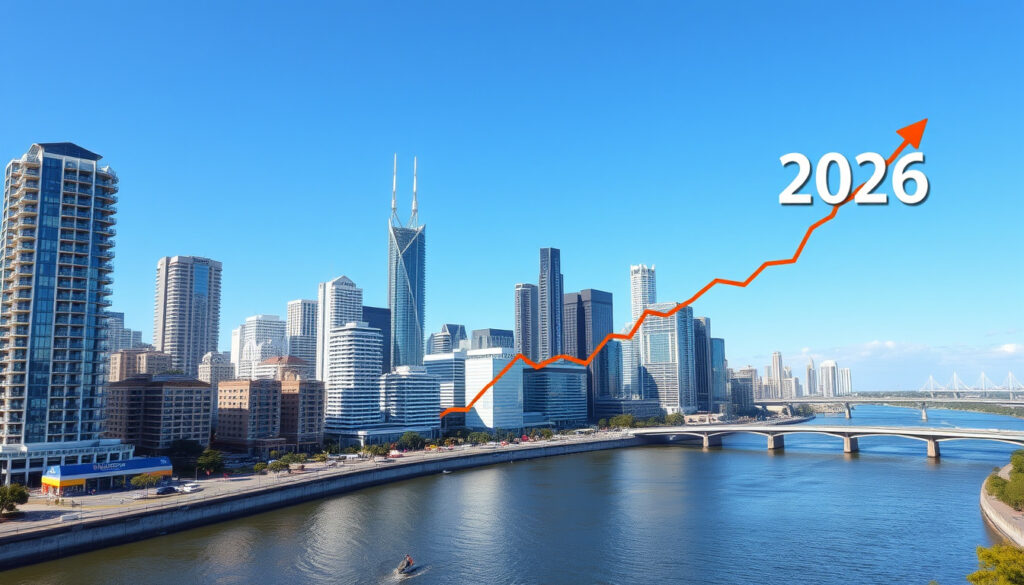
Real Estate Brisbane: Market Trends and 2026 Outlook
Brisbane’s property market just crossed a milestone that would have seemed impossible a decade ago — the city’s median house price pushed past $1 million in mid-2025 and hasn’t looked back. For anyone watching from the sidelines, the question now isn’t whether Brisbane is expensive, but whether the momentum still justifies getting in before prices climb further. This guide cuts through the noise to give you the real picture heading into 2026.
Properties for sale in Brisbane Greater Region: 5229 ·
Properties for sale in Brisbane City: 773 ·
Median rent in Brisbane City: $760 per week ·
Houses for sale in Brisbane City: 107 ·
Apartments for sale in Brisbane City: 502
Quick snapshot
- Brisbane median house price: $1.13 million in early 2026 (Spot On Conveyancing)
- Dwelling values up 15.7% annually as of January 2026 (OpenAgent)
- ANZ forecasts 9.7% house price growth in 2026 (Property Update)
- Exact suburb booms: specific growth areas shift depending on data source
- 2027 slowdown scale: ANZ predicts 1.4%, but forecasts vary widely
- Olympics infrastructure timelines remain vague for some projects
- 2021: Olympics announcement drives prices 37% above national average (Property Update)
- May 2025: Median house price crosses $1 million milestone (Spot On Conveyancing)
- Jan 2026: Dwelling values +1.6% monthly, +15.7% yearly (OpenAgent)
- KPMG forecasts 10.9% house price growth in 2026 (Smart Property Investment)
- Units expected to outperform houses at 7-10% growth due to affordability pressure (Smart Property Investment)
- Brisbane to lead Australian capital cities in price gains through 2030 (Smart Property Investment)
| Metric | Value | Source |
|---|---|---|
| Properties for sale Greater Brisbane | 5,229 | Domain data |
| Brisbane City sales listings | 773 | Domain data |
| Median weekly rent Brisbane City | $760 | Domain data |
| Houses for sale Brisbane City | 107 | Domain data |
| Apartments for sale Brisbane City | 502 | Domain data |
Are house prices still rising in Brisbane?
Short answer: yes, and the trajectory shows few signs of flattening. Brisbane’s property market has built real momentum over the past few years, with annual dwelling value growth hitting 15.7% as of January 2026 — a figure that puts Australia’s third-largest city well ahead of most comparable markets nationally.
Current trends
The numbers tell a clear story. CoreLogic data places Brisbane’s median house price at approximately $1.13 million in early 2026, a figure that would have seemed fanciful a decade ago. Domain forecasts suggest the city could reach $1.09 million by mid-2026. The trajectory from the $1 million milestone crossed in May 2025 has been steep and consistent.
Brisbane dwelling values climbed 1.6% in January 2026 alone, suggesting buyer demand remains robust despite higher interest rates and global economic tensions. Supply shortages are a key driver — listing volumes sit 16% below historical averages, with advertised supply running 29% below the five-year average.
ANZ Research forecasts Brisbane house price growth of 9.7% in 2026 before a potential slowdown to 1.4% in 2027. The bank notes that this forecast positions Brisbane among the strongest-performing capital cities in the country. KPMG goes further, projecting double-digit growth of 10.9% for houses and 11.6% for units in 2026.
“The forecast for the Brisbane property market in 2026 is one of continued strength, driven by a supply crisis.”
— Spot On Conveyancing, conveyancing industry analysis
Units are currently outperforming houses in percentage terms — analysts at OpenAgent note this is driven primarily by affordability pressure, as first-home buyers and investors gravitate toward lower entry points. Forecast ranges put unit growth at 7-10% for 2026 versus 4-8% for houses, though KPMG’s higher-end estimates suggest those ranges may be conservative.
Forecast impacts
Property Buyer analysis suggests Brisbane house prices could grow 31% from 2025 to 2030, reaching approximately $1.45 million by the end of the decade. Whether that timeline holds depends heavily on Olympics infrastructure delivery, migration patterns, and the broader interest rate environment.
The market’s resilience through rate rises and geopolitical uncertainty speaks to structural demand fundamentals rather than speculative froth. Low vacancy rates and interstate migration exceeding 25,000 people annually provide a floor beneath prices, even if growth rates moderate.
Brisbane’s price growth has shifted from explosive to sustained. Buyers who entered in 2023 or 2024 have already seen substantial gains, while those waiting on the sidelines face a market where entry points have permanently shifted upward.
Which suburbs in Brisbane will boom in 2026?
Brisbane’s growth story isn’t uniform across the map. Certain suburbs are punching well above the city average, driven by a mix of affordability relative to the inner city, infrastructure investment, and demographic shifts. Identifying these hotspots before they fully price in could be the difference between a solid investment and a merely adequate one.
Top growth areas
OpenAgent’s January 2026 suburb rankings put Springwood-Kingston at the top of the growth list, with a median price of $922,327 and a remarkable 22.4% annual growth rate. This southern corridor suburb has attracted buyers seeking relative affordability with strong fundamentals.
Chermside ranks among the highest medians in the growth suburbs at $1,272,406, yet still delivered 17.7% annual growth. Industry analysts point to ongoing gentrification and development potential as key drivers. Rocklea-Acacia Ridge posted 18.6% growth with a median of $1,173,611.
Other suburbs drawing consistent attention include Nundah, Chermside, and Coorparoo for units and townhouses, while Property Update identifies South Brisbane, Greenslopes, Carina, Camp Hill, Stafford, and Kedron as broader booming zones. Springfield-Redbank placed sixth in OpenAgent’s rankings with 18.4% growth and a $903,021 median.
“Brisbane will lead Australia’s capital cities in residential property price gains.”
— Property Buyer, property investment analysts
Investment potential
Middle-ring suburbs — roughly 10 to 20 kilometres from the CBD — are drawing particular interest from investors focused on yield versus pure capital growth. Tora Finance identifies north Brisbane growth corridors and southern investment areas as particularly strong, with gentrification trends in suburbs like Chermside adding momentum.
Brokers note that bidding wars have emerged in suburbs like Tarragindi, Salisbury, and Keperra, indicating competitive buyer conditions in value-oriented areas. For investors, the middle ring offers a balance: prices remain accessible compared to inner-city suburbs, while growth rates have been competitive with premium areas.
The north Brisbane growth corridor and south-side investment areas are both attracting attention from analysts tracking migration patterns and infrastructure spend. Chermside’s development trajectory, including commercial and retail upgrades, positions it as a potential long-term winner.
Springwood-Kingston’s 22.4% growth makes it a standout, but the sheer velocity raises questions about sustainability. Buyers should assess whether local fundamentals — employment access, amenities, rental demand — can justify such rapid appreciation.
Is it worth buying property in Brisbane?
The decision to buy in Brisbane isn’t straightforward. Prices have risen substantially, affordability has compressed, and the market now sits at levels that would have seemed unimaginable five years ago. That said, the structural case for Brisbane remains stronger than many critics acknowledge.
Pros and cons
Upsides
- Brisbane median house price ($1.11M-$1.13M) remains $472,694 cheaper than Sydney (Enaybl property analysis)
- Rental yields of 4.5-5.5% outperform many comparable cities (Enaybl property analysis)
- Olympics 2032 infrastructure investment provides long-term demand support (Property Update market report)
- Interstate migration adding over 25,000 residents annually (Enaybl property analysis)
- Brisbane to lead Australian capital cities in price gains through 2030 (Property Buyer investment guide)
- Supply shortages keep upward pressure on prices (OpenAgent suburb profiles)
Downsides
- Prices have tripled in some suburbs over the past decade
- ANZ forecasts growth slowdown to 1.4% in 2027 after 9.7% in 2026 (Property Update market report)
- Entry points now require household incomes well above median
- Unit growth outpacing houses suggests affordability is fragmenting the market
- Advertised supply 29% below five-year average limits buyer options (OpenAgent suburb profiles)
Market forecast
For buyers with a 5-10 year horizon, the structural case for Brisbane remains solid. Population growth, employment expansion, and Olympics-driven infrastructure create a foundation that most analyst houses view as durable. The city has outperformed Sydney and Melbourne on affordability, and that relative advantage hasn’t fully eroded despite price rises.
For investors seeking shorter-term returns, the calculus is tighter. The 2027 slowdown forecast from ANZ suggests price appreciation may moderate substantially after 2026. Rental yields remain competitive, but capital growth expectations should be recalibrated downward from the explosive levels seen over the past few years.
Can you buy a house in Brisbane for $500,000?
The $500,000 threshold has become increasingly mythical in Brisbane’s established suburbs. With the city median sitting well above $1 million, finding detached houses at that price point requires looking at specific postcode pockets or accepting trade-offs on location and property type.
Affordable options
Spot On Conveyancing analysis identifies bidding wars in suburbs like Tarragindi, Salisbury, and Keperra — all suburbs where affordable detached housing once existed but is now being competed away. The reality is that $500,000 for a house in Brisbane increasingly means either a smaller property, a suburb further from the CBD, or accepting conditions that require significant renovation work.
Units offer a more realistic path to the $500,000 bracket. Apartment listings in Brisbane City total 502, representing a meaningful portion of the market. For buyers willing to consider apartment living, particularly in middle-ring suburbs, sub-$500,000 options exist and can provide solid rental yields.
The critical question is whether the property serves its intended purpose. First-home buyers seeking an entry point should weigh the trade-off between location, property type, and the likelihood of future capital growth. Properties at the lower end of the market in growth suburbs may offer better long-term value than premium units in established areas.
Suburb examples
Based on available data, outer suburbs and specific middle-ring pockets still offer relatively affordable entry points. Springwood-Kingston, with its $922,327 median, sits above the $500,000 threshold, but surrounding areas in Brisbane’s south offer more accessible pricing. The trade-off is always commute time and amenity access.
Units in suburbs like Nundah and Chermside frequently appear below $500,000, though these attract strong investor interest given the rental demand in those areas. For owner-occupiers, the decision between a unit in a desirable suburb versus a house further out requires careful personal assessment of lifestyle priorities.
The implication: buyers clinging to the $500,000 house ideal in established Brisbane suburbs face a narrowing window of opportunity as price growth continues to compress affordable options.
The $500,000 question matters because it defines who can still enter the Brisbane market without substantial family support or exceptional incomes. For first-home buyers specifically, the answer increasingly involves units or outer-suburb houses rather than the detached family home dream.
Should I buy a house in Brisbane in 2026?
The decision ultimately depends on your time horizon, financial position, and willingness to accept a market that has already delivered substantial gains to earlier buyers. For those with stable incomes and a 7-10 year view, the structural case remains intact.
Buyer considerations
2026 presents a mixed picture for buyers. On one hand, continued growth of 7-11% (or higher per KPMG) means today’s entry price will likely look cheap in retrospect by 2030. On the other hand, buying at the peak of a growth cycle carries timing risk — ANZ’s own forecast suggests growth could slow to 1.4% in 2027.
For owner-occupiers with stable employment and long-term residency plans, the cyclical risk is reduced. The Olympics infrastructure build-out, ongoing interstate migration, and structural housing undersupply provide reasons to believe Brisbane’s fundamentals will remain supportive.
For investors, the calculation is more nuanced. Rental yields of 4.5-5.5% are competitive, but capital growth expectations should be tempered. The market that delivered 15.7% annual growth isn’t the same market that will deliver 9.7% — the mathematics of a higher base means percentage gains translate to larger absolute increases, but the velocity has moderated.
Salary and costs
Brisbane’s cost of living remains more manageable than Sydney or Melbourne, but property costs have compressed affordability substantially. Households seeking to service a mortgage on a median-priced property need incomes well above the Queensland median. The exact threshold depends on interest rates, deposit size, and loan terms.
For first-home buyers, the Queensland First Home Loan Deposit Scheme and similar initiatives can help bridge the gap, but the reality is that Brisbane’s market has moved beyond reach for many aspirational buyers. Those who can still enter should do so with clear eyes about trade-offs versus renting and the commitment required.
Buyers face a classic timing dilemma: enter now at historically high prices but before further appreciation, or wait and hope for a correction that may not come. The structural demand drivers — migration, Olympics, supply constraints — suggest waiting carries its own costs.
How does Brisbane compare to other cities?
Brisbane’s relative positioning against Sydney and Melbourne tells much of the story for investors and migrants considering a move north. The comparison has shifted dramatically over the past five years.
Three cities dominate the comparison: Sydney remains Australia’s most expensive property market, Melbourne has softened considerably from its peaks, and Brisbane has climbed to sit between them. The gap between Brisbane and Sydney on median house prices remains substantial, making Brisbane appear affordable by comparison despite its rapid appreciation.
This head-to-head comparison shows where Brisbane holds advantages and where challenges remain.
| Comparison | Brisbane | Competitor | Difference |
|---|---|---|---|
| Median house price (early 2026) | $1.13M | Sydney: $1.60M+ | Brisbane $472k cheaper (Enaybl property analysis) |
| 2026 growth forecast | 9.7% (ANZ) | Melbourne: lower | Brisbane leads capitals (Property Update market report) |
| Rental yields | 4.5-5.5% | Sydney/Melbourne: lower | Brisbane superior yields (Enaybl property analysis) |
| 2032 Olympics impact | Core driver | N/A for rivals | Brisbane unique infrastructure boost (Property Update market report) |
The comparison framework matters for decision-making. Property Buyer forecasts Brisbane will lead Australian capital cities in residential property price gains through 2030 — a significant claim that positions the city as Australia’s growth market for the decade ahead. Whether that proves accurate depends on execution of Olympics infrastructure, migration policy, and broader economic conditions.
Related reading: best home insurance · Temporary Graduate Visa (485)
Frequently asked questions
What salary do you need to live comfortably in Brisbane?
Comfortable living in Brisbane depends on household composition and lifestyle, but servicing a mortgage on a median-priced property requires substantially above the Queensland median income. Exact thresholds vary by interest rate, deposit size, and loan structure. Brisbane remains more affordable than Sydney for equivalent property quality.
Which suburb is best for investment in Brisbane?
Based on 2026 data, Springwood-Kingston leads growth metrics at 22.4% annual appreciation. Chermside offers a strong combination of high median ($1.27M) and solid growth (17.7%). For investors focused on yield, middle-ring suburbs like Nundah and Chermside offer competitive rental demand with development upside.
What are the disadvantages of living in Brisbane?
Key disadvantages include: summer humidity and heat, less public transport infrastructure than Sydney or Melbourne, employment opportunities concentrated in specific sectors, and property prices that have risen faster than local wages in recent years. The city also lacks some of the cultural amenities of larger capitals.
Where do British expats live in Brisbane?
British expats in Brisbane tend to concentrate in established inner-suburbs and middle-ring areas with lifestyle amenities, good schools, and commute access. Suburbs like New Farm, West End, and Teneriffe attract those seeking inner-city living, while areas like Kenmore and Pullenvale appeal to families seeking more space.
What factors affect buying in Brisbane?
Key factors include: interest rate environment, employment stability, migration patterns, Olympics infrastructure delivery, supply constraints, and personal financial position. The market has supply shortages with listing volumes 16% below historical averages, creating persistent upward pressure. For investors, yield versus growth priorities should guide suburb selection.
How does interstate migration impact Brisbane property?
Interstate migration exceeding 25,000 residents annually creates sustained demand pressure that supports both rental yields and capital growth. This population influx, combined with limited new supply, provides a structural floor beneath Brisbane prices even during periods of broader market cooling.
More related posts
 Taylor Swift Albums in Order: Complete Discography 2025
 DNA Testing in Ireland: Costs, Accuracy, and Key Facts
 Adam Scott Golfer: Net Worth, Wife, Family, Age & Ranking
 Paddy Pimblett: Record, Net Worth, Next Fight
 James Bulger: Latest Verified Facts and Case Updates
 James Duckworth: Biography, Ranking & Prize Money
 Jim Henson: Cause of Death, LGBTQ Support, and Lasting Legacy
 Julie Bowen: Heart Condition, Plastic Surgery, and Fitness
