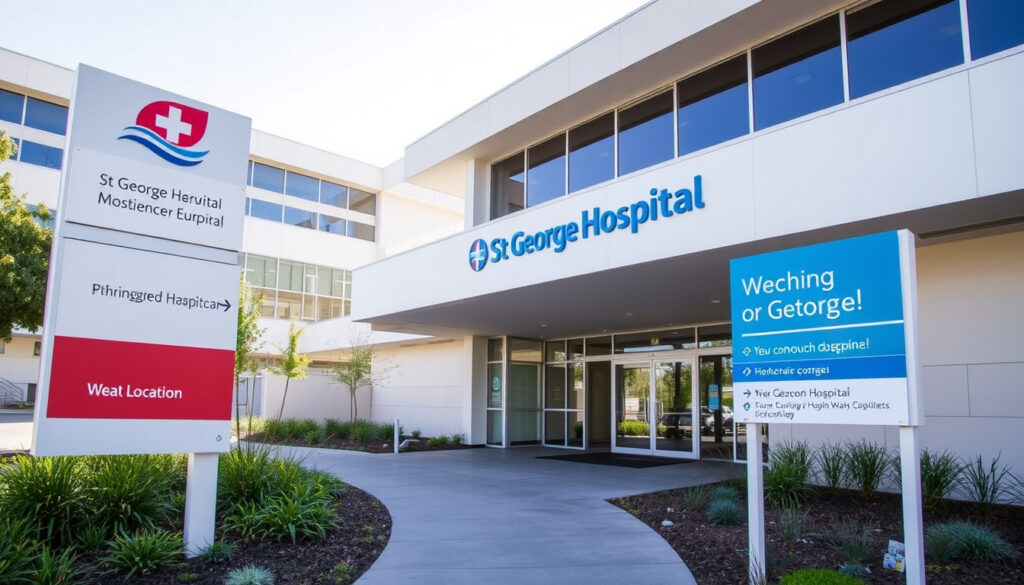
St George Hospital – Guide to Location, Services and Contact
St George Hospital is a major tertiary referral facility located in Kogarah, a southern suburb of Sydney, Australia. As one of the largest hospitals in Sydney, it serves as a principal teaching hospital of the University of New South Wales and plays a critical role in providing specialist medical services to the region. The hospital operates around the clock, offering emergency care, trauma services, and a comprehensive range of medical and surgical specialties to approximately 250,000 residents in the St George area and an additional 200,000 residents from the nearby Sutherland Shire.
This guide covers the hospital’s location, contact details, services, facilities, and historical development to help patients, visitors, and healthcare professionals access the information they need.
Where is St George Hospital Located and How to Get There?
St George Hospital is situated at 28 Gray Street, Kogarah, NSW 2217, Australia. The facility occupies a prominent position on the corner of Gray Street, making it accessible from several directions within the suburb.
Entry Points and Accessibility
The hospital provides multiple entry points to accommodate visitors arriving from different directions. The main entry is via Gray Street, which serves as the primary access point for patients and visitors. Additional entry options include the Belgrave Street entrance and the Kensington Street entry, offering flexibility depending on where visitors are approaching from.
For those using public transport, Kogarah Station on Railway Parade is approximately 500 metres from the hospital grounds. Bus and train timetables can be accessed through Transport NSW for planning purposes.
Parking Information
Paid parking stations are available at three locations: Gray Street, Belgrave Street, and Kensington Street. Concessional parking concessions include 11 spaces at the Gray Street carpark and 6 spaces at the Belgrave Street carpark. The hospital also provides parking information through the HosPark mobile application. A separate facility, St George Private Hospital located at the corner of Princes Highway and South Street, recently expanded its parking capacity with 131 additional car spaces including disabled parking.
The hospital is approximately 500 metres from Kogarah train station. Multiple entry points allow access from Gray Street, Belgrave Street, or Kensington Street. Paid parking is available at all three locations.
Contact Details and Opening Hours for St George Hospital
How to Reach the Hospital
For general enquiries and assistance, the hospital’s main telephone number is (02) 9113 1111. Patients and visitors can use this number to contact various departments, confirm appointment details, and obtain information about services. The official website provides additional resources and up-to-date information at www.seslhd.health.nsw.gov.au/st-george-hospital.
| Contact Method | Details |
|---|---|
| Phone | (02) 9113 1111 |
| Website | www.seslhd.health.nsw.gov.au/st-george-hospital |
| Address | 28 Gray Street, Kogarah, NSW 2217 |
| Main Reception Weekdays | 8:00am to 8:00pm |
| Main Reception Weekends | 10:00am to 8:00pm |
| Emergency Department | 24 hours daily |
Visiting Hours and Availability
The Emergency Department at St George Hospital operates 24 hours daily, seven days a week, ensuring continuous access to urgent medical care. Main reception hours are 8:00am to 8:00pm on weekdays and 10:00am to 8:00pm on weekends and public holidays. These hours apply to the main reception desk where visitors can obtain visitor passes, directions, and general assistance.
Call ahead to confirm appointment times and any specific requirements. The hospital’s main phone number (02) 9113 1111 connects callers to the relevant department for enquiries about scheduled procedures, visiting arrangements, and patient information.
Services and Facilities at St George Hospital
St George Hospital is recognised as one of the leading trauma and emergency management centres in New South Wales. The facility houses a designated medical trauma service and serves as the Medical Retrieval Service Coordination Centre for NSW, reflecting its critical role in the state’s emergency healthcare network. Current operational information and wait time estimates are available through the NSW Health website.
Key Services and Specialties
The hospital offers an extensive range of medical and surgical services through its multiple departments and specialist units. The comprehensive list of specialties includes anaesthesia and critical care, general and cardiothoracic surgery, cancer care, internal medicine, women’s and children’s health, mental health services, community health programs, medical imaging, aged care and rehabilitation, and allied health services.
Hospital Capacity and Resources
With approximately 600 beds and more than 2,500 staff members (measured in full-time equivalents), St George Hospital maintains substantial capacity to serve its catchment population. The 2017 redevelopment added significant infrastructure, including a 52-bed intensive care and high-dependency unit with 38 funded beds, 128 additional inpatient beds, and eight digital and interventional operating theatres. This expansion enhanced the hospital’s ability to deliver advanced medical procedures and complex surgical interventions. More details on the redevelopment project can be found on the Multiplex website.
Catchment Area and Patient Volume
The hospital primarily serves approximately 250,000 residents of southern Sydney in the St George area, which is bounded by Botany Bay, Cooks River, Georges River, and Salt Pan Creek. Additionally, St George Hospital functions as the nearest specialist medical services provider for around 200,000 residents of the Sutherland Shire. In the 2002-2003 financial year, the hospital recorded more than 45,000 admissions (including day-only patients) and over 723,000 outpatient treatments, illustrating the scale of services delivered to the community.
History and Background of St George Hospital
St George Hospital has evolved significantly since its establishment as a major healthcare facility in southern Sydney. Understanding this history provides context for its current role as a leading tertiary referral and teaching hospital.
Establishment and Teaching Hospital Status
In 1964, St George Hospital became a teaching hospital with specialised departments, marking an important milestone in its development. This designation established the foundation for its ongoing relationship with medical education and research, later formalised through its partnership with the University of New South Wales.
Major Redevelopments
The late 1980s saw a significant transformation with a A$200 million redevelopment that elevated the facility to tertiary teaching hospital status. This investment substantially expanded the hospital’s infrastructure and capabilities.
The most recent major development occurred in 2017, when the hospital completed a A$277 million redevelopment. Multiplex constructed a 9-level Acute Services Building, notable as the first building of its scale in New South Wales to be constructed directly above an operational 24-hour Emergency Department. This achievement demonstrated innovative planning to maintain continuous emergency services during construction.
The 2017 A$277 million Acute Services Building became the first structure of its scale in NSW built directly above an active 24-hour Emergency Department, representing a significant engineering and healthcare planning achievement.
St George Hospital: A Timeline of Key Events
The following timeline outlines the significant milestones in the development of St George Hospital from its establishment to its most recent expansion.
- 1964: St George Hospital becomes a teaching hospital with specialised departments, establishing its foundation in medical education.
- Late 1980s: Completion of A$200 million redevelopment transforms the facility into a tertiary teaching hospital.
- 2002-2003: Hospital records more than 45,000 admissions and 723,000 outpatient treatments, demonstrating high patient volumes.
- 2017: Completion of A$277 million redevelopment includes 9-level Acute Services Building constructed above the Emergency Department.
- Ongoing: Hospital continues serving as principal teaching hospital for University of New South Wales and trauma centre for NSW.
Understanding St George Hospital: What Is Established and What Remains Uncertain
| Established Information | Information That May Require Clarification |
|---|---|
| St George Hospital in Sydney is at 28 Gray Street, Kogarah, NSW 2217 | There are multiple St George Hospitals globally, including facilities in London and Utah. Queries may refer to any of these locations. |
| The Sydney facility is a tertiary referral hospital with ~600 beds | Real-time emergency department wait times are not included in this guide. Check the NSW Health website for current estimates. |
| Phone number is (02) 9113 1111 | Specific departmental contact numbers may vary. The main number redirects to relevant departments. |
| Hospital operates 24/7 emergency services | Visitor policies may change during pandemic periods or special circumstances. Confirm before visiting. |
| Established as teaching hospital in 1964 | Some historical details may not be publicly documented. This guide covers verified information from official sources. |
The Role of St George Hospital in Regional Healthcare
St George Hospital occupies a vital position within the New South Wales healthcare system as a major tertiary referral facility. Its designation as the Medical Retrieval Service Coordination Centre for NSW underscores its importance in emergency medical response across the state. The hospital serves as the primary specialist medical services provider for a combined population exceeding 450,000 residents across the St George and Sutherland Shire areas.
As a teaching hospital affiliated with the University of New South Wales, St George Hospital contributes to medical education and research alongside its clinical services. This dual role enables the facility to maintain access to current medical practices and innovations while training future healthcare professionals.
The hospital’s comprehensive range of services—from emergency trauma care to aged care rehabilitation—reflects its commitment to serving the diverse healthcare needs of southern Sydney. The substantial investment in infrastructure, particularly the 2017 redevelopment, demonstrates ongoing commitment to expanding capabilities and meeting growing demand for specialist medical services.
Information Sources and References
The information presented in this guide has been compiled from official hospital sources and established reference materials. Key sources include the South Eastern Sydney Local Health District website, which provides current operational information, and publicly available records documenting the hospital’s history and development.
St George Hospital serves as a principal teaching hospital of the University of New South Wales and is among the largest hospitals in Sydney.
— South Eastern Sydney Local Health District / Wikipedia
The 2017 A$277 million redevelopment included construction of a 9-level Acute Services Building—the first of its scale in New South Wales to be constructed directly above an operational 24-hour Emergency Department.
— South Eastern Sydney Local Health District / Wikipedia
Summary
St George Hospital in Kogarah, Sydney, represents a cornerstone of healthcare delivery in southern New South Wales. With approximately 600 beds, more than 2,500 staff members, and comprehensive services spanning emergency medicine, surgery, cancer care, and rehabilitation, the facility serves a catchment population exceeding 450,000 residents. The hospital’s commitment to teaching and research through its University of New South Wales affiliation ensures continued advancement in medical practice. For contact, the main telephone number is (02) 9113 1111, and the facility operates 24-hour emergency services with reception available from 8:00am to 8:00pm on weekdays. Understanding your health needs and available services helps in planning effective care. For related information about maintaining wellness, consider reading about Fish Oil Benefits.
Frequently Asked Questions
Is St George Hospital open now?
Yes. The Emergency Department operates 24 hours daily, seven days a week. Main reception hours are 8:00am to 8:00pm on weekdays and 10:00am to 8:00pm on weekends and public holidays.
What are St George Hospital emergency department wait times?
Current emergency department wait times are available through the NSW Health website or the hospital’s official channels. Wait times vary based on patient volume and acuity levels.
Does St George Hospital have parking?
Yes. Paid parking is available at Gray Street, Belgrave Street, and Kensington Street. Concessional parking includes 11 spaces at Gray Street carpark and 6 spaces at Belgrave Street carpark.
What is the phone number for St George Hospital?
The main telephone number is (02) 9113 1111. This number connects callers to the relevant department for general enquiries, appointments, and patient information.
What services does St George Hospital offer?
The hospital offers services including emergency and trauma care, surgery and cardiothoracic surgery, cancer care, medicine, women’s and children’s health, mental health, community health, medical imaging, aged care and rehabilitation, and allied health services.
When was St George Hospital founded?
The hospital became a teaching hospital in 1964, marking the establishment of specialised departments and its foundation as a major healthcare facility.
Which St George Hospital is the main one?
The St George Hospital in Sydney, located at 28 Gray Street, Kogarah, is a major tertiary referral facility and one of the largest hospitals in Sydney. There are other St George Hospitals in London and Utah, but this guide focuses on the Sydney facility.
How do I get to St George Hospital by public transport?
Kogarah Station on Railway Parade is approximately 500 metres from the hospital. Bus and train timetables are available through Transport NSW. The hospital is also accessible via multiple entry points from Gray Street, Belgrave Street, and Kensington Street.
More related posts
 Whoopi Goldberg’s Pneumonia Battle: Health and Family Facts
 Son of Sardaar 2 – Release Date, Cast & Plot Details
 White Maxi Dress: Weddings, Casual & Formal Styling
 Atom Eve: Powers, Relationships, and Origins Explained
 2000 AUD to USD: Convert Australian Dollars
 Cloud Storage Free Plans – Top Providers Compared 2025
 Free ATMs Near Me: Avoid Fees in Ireland & Australia
 Lana Wilkinson: Fashion Stylist, Shoe Designer, and Net Worth
