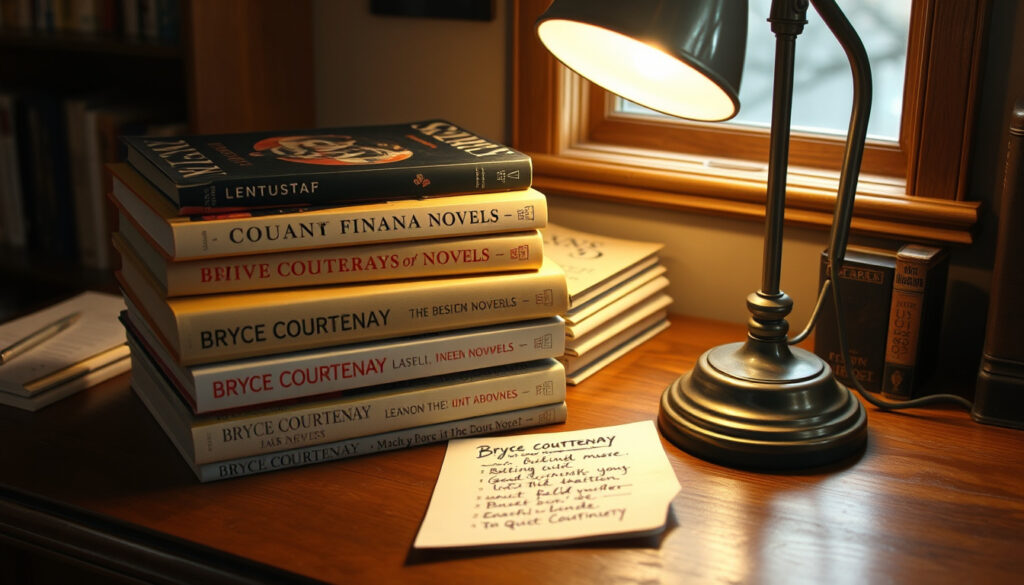
Bryce Courtenay Books: Reading Order, Facts & Controversies
Few novels arrive with the backstory of a former advertising executive who claimed his debut was largely autobiographical — only to later admit he’d bent the truth. Bryce Courtenay’s The Power of One has sold millions worldwide, but the man behind it remains as polarizing as his work. This guide separates the publishing milestones from the personal mythology, giving you the reading order, the facts, and the controversies that still surround Australia’s most commercially successful novelist.
Books published: 21 novels ·
Best-known work: The Power of One ·
Sales in Australia: Over 10 million copies ·
Born: 14 August 1933 ·
Died: 22 November 2012 ·
Nationality: South African-Australian
Quick snapshot
- Born in South Africa, 14 August 1933 (Wikipedia)
- Worked in advertising before writing novels (Britannica Kids)
- The Power of One published 1989 (Wikipedia)
- Died 22 November 2012 in Canberra (Wikipedia)
- Exact degree of autobiography in childhood stories (Australian Insight)
- Whether specific boxing matches in the novel occurred (Australian Insight)
- Whether his father was abusive as depicted (Australian Insight)
- How much of The Power of One is autobiographical is disputed (Australian Insight)
- Publication date of The Night Country is inconsistent across sources (Australian Insight)
- Exact sales figures for The Power of One are estimates (Wikipedia)
- 1933: Born in South Africa (Wikipedia)
- 1989: The Power of One published (Wikipedia)
- 1995: Australian trilogy begins (Britannica Kids)
- 2012: Died in Canberra (Wikipedia)
- Continued debate over racial portrayals in his work (Australian Insight)
- Film adaptations remain in cultural conversation (Britannica Kids)
- New readers discovering his books through reading-order guides (Australian Insight)
Six key facts, one pattern: Courtenay’s publishing career spanned just 23 years but produced 21 novels, two distinct series, and one of the best-known debuts in Australian literature.
| Field | Value |
|---|---|
| Full name | Arthur Bryce Courtenay |
| Born | 14 August 1933, South Africa |
| Died | 22 November 2012, Canberra, Australia |
| Occupation | Novelist, advertising director |
| Notable work | The Power of One |
| Awards | Officer of the Order of Australia (AM) |
What is Bryce Courtenay’s most famous book?
Overview of The Power of One
- Published in 1989 (Wikipedia)
- Main character: Peekay, a young British South African boy (Britannica Kids)
- Semi-autobiographical framework, heavily fictionalized (Australian Insight)
Every discussion of Courtenay begins with The Power of One. It’s the book that made him a household name across Australia and beyond, selling millions of copies and being adapted into a 1992 film directed by Richard Attenborough.
Why it is considered his signature work
- First novel, published when Courtenay was 56
- Widely taught in Australian schools
- Spent months on bestseller lists
The pattern: a late-career debut that outperformed nearly every other Australian novel of its decade.
Legacy and cultural impact
- Film adaptation directed by Richard Attenborough, 1992
- Translated into multiple languages
- Sparked ongoing debate about racial stereotypes
What this means: the novel’s reach extended far beyond literature into film and cultural criticism, making it a lightning rod for both praise and scrutiny.
How much of The Power of One is true?
Autobiographical elements in the story
- Courtenay spent time in a boarding school in South Africa
- He was bullied as a child, similar to Peekay
- Boxing features prominently in both his biography and the novel
Differences between Peekay and Courtenay’s life
- Peekay is an only child; Courtenay had siblings
- Courtenay never fought as a champion boxer
- Many dramatic events in the novel are invented
Courtenay’s admission of embellishment
- Courtenay told interviewers he took creative liberties
- An Australian Financial Review investigation described “lying was his survival mechanism”
- The novel is now marketed as “semi-autobiographical” rather than autobiographical
The catch: readers expecting a memoir will find a novel; readers accepting a novel will find threads of a real life.
Courtenay built his brand on the idea of authenticity — but his own background in advertising taught him that a well-told story often matters more than the literal truth. For readers, the question isn’t “did this happen?” but “does the storytelling hold up?”
The implication: the line between fact and fiction is deliberately blurred, and Courtenay’s own admissions confirm that the novel is a crafted work, not a memoir.
What are Bryce Courtenay’s best-selling novels?
The Power of One
- Sold millions worldwide
- Over 10 million copies in Australia alone
- Translated into more than 20 languages
Tandia
- Published 1992
- Sequel to The Power of One
- Continues Peekay’s story in Australia
April Fool’s Day
- Published 1993
- Nonfiction memoir about his son Damon, who had hemophilia
- Bestselling non-fiction in Australia
The Potato Factory
- Published 1995
- First of the Australian trilogy
- Historical fiction set in 19th century
The trade-off: Courtenay’s biggest commercial successes came from his first two series — the duology and the Australian trilogy — while his standalone novels sold respectably but never matched that early momentum.
What order to read Bryce Courtenay books?
Chronological order by publication
- 1989: The Power of One
- 1992: Tandia
- 1993: April Fool’s Day
- 1995: The Potato Factory
- 1997: Tommo and Hawk
- 1999: Solomon’s Song
- 2002: Matthew Flinders’ Cat
- 2004: Brother Fish
- 2005: Whitethorn
- 2007: The Persimmon Tree
- 2008: Fishing for Stars
- 2009: The Story of Danny Dunn
- 2010: Fortune Cookie
- 2012: Jack of Diamonds
Series order (Australian trilogy)
- Book 1: The Potato Factory (1995)
- Book 2: Tommo and Hawk (1997)
- Book 3: Solomon’s Song (1999)
Suggested reading order for newcomers
- Start with The Power of One
- Continue with Tandia for completion of the duology
- Then The Potato Factory for the Australian trilogy
- April Fool’s Day as a change of pace (non-fiction)
Why this matters: new readers who start with his standalone novels risk missing the narrative arcs that made Courtenay famous. The duology and trilogy are his strongest work.
A discrepancy exists: some reading-order sources list The Night Country as a 2012 release, while other authoritative sources place it earlier. Stick with the Britannica-kids.org chronology for publication dates, as it’s consistently cited by libraries and educators.
Is The Power of One racist?
Criticisms of racial portrayal
- Some critics argue the novel reinforces stereotypes about Black South Africans
- White savior narrative structure identified by reviewers
- Debate continues on academic and reader forums
Historical context of apartheid South Africa
- Novel set in 1930s–1950s South Africa under apartheid
- Courtenay defended portrayals as accurate to the era
- Some readers view it as a product of its time
Perspectives from reviewers and readers
- Positive: praised for exposing apartheid’s brutality to a wide audience
- Negative: criticized for one-dimensional Black characters
- Mixed: acknowledged as well-intentioned but flawed
The implication: readers should approach the novel as a work of its era, aware that its treatment of race has become a subject of legitimate debate — not a settled question.
Is The Power of One worth reading?
Critical reception and reader reviews
- Widely praised for storytelling and emotional depth
- Criticized for length and pacing — over 500 pages
- Considered a must-read for fans of historical fiction
Themes of resilience and identity
- Central theme: overcoming adversity through determination
- Identity formation in a divided society
- Boxing as metaphor for personal struggle
Upsides
- Compelling, fast-paced narrative despite length
- Emotionally resonant coming-of-age story
- Introduces readers to apartheid-era South Africa
- Serves as entry point to Courtenay’s entire oeuvre
Downsides
- Pacing issues in middle sections
- Racial portrayals problematic for some readers
- Autobiographical claims misleading
- Sequel Tandia less critically acclaimed
The pattern: The Power of One remains a cultural touchstone that rewards reading if you’re prepared to engage critically with its content — not as pure autobiography, but as a crafted novel with both strengths and flaws.
How to start reading Bryce Courtenay (steps for newcomers)
- Decide your entry point: fiction fans start with The Power of One; non-fiction readers start with April Fool’s Day
- Commit to the duology: read Tandia immediately after The Power of One for narrative continuity
- Move to the Australian trilogy: The Potato Factory, Tommo and Hawk, Solomon’s Song in order
- Read standalones: tackle Matthew Flinders’ Cat, Brother Fish, and later novels by publication date
- Explore the non-fiction: April Fool’s Day offers emotional depth and biographical context
For Australian readers, the added layer is cultural: Courtenay’s books are embedded in the national reading landscape, so understanding his work means understanding a piece of Australian publishing history.
Timeline: Bryce Courtenay’s life and career
- 1933: Born in South Africa (Wikipedia)
- 1950s: Moved to Australia (Wikipedia)
- 1960s–1980s: Career in advertising; created iconic campaigns like Louie the Fly (Wikipedia)
- 1989: Published first novel, The Power of One (Wikipedia)
- 1991: Published sequel Tandia (Britannica Kids)
- 1993: Published April Fool’s Day (Britannica Kids)
- 1995: Published The Potato Factory, start of Australian trilogy (Britannica Kids)
- 2012: Died in Canberra, Australia (Wikipedia)
The through-line: Courtenay’s creative output accelerated after age 50, suggesting that his advertising career was less a detour than a training ground for the disciplined storytelling that followed.
Clarity: what’s confirmed and what’s not
Confirmed facts
- Courtenay attended boarding school in South Africa (Wikipedia)
- He worked in advertising before writing novels (Britannica Kids)
- He was awarded the Order of Australia (Wikipedia)
- He wrote 21 novels in 23 years (Britannica Kids)
- His books have sold over 10 million copies in Australia (Wikipedia)
What remains unclear
- Whether specific boxing matches in The Power of One actually occurred (Australian Insight)
- The exact degree of autobiographical detail in his childhood stories (Australian Insight)
- Whether his father was abusive as depicted in his novels (Australian Insight)
- How much of The Power of One is autobiographical is disputed (Australian Insight)
- Publication date of The Night Country is inconsistent across sources (Australian Insight)
- Exact sales figures for The Power of One are estimates (Wikipedia)
“For Bryce Courtenay, ‘lying was his survival mechanism'”
— Australian Financial Review, 2025
“He is one of Australia’s best-selling authors”
— Wikipedia
“The late Bryce Courtenay was the bestselling author of The Power of One”
— Penguin Australia author page
For readers deciding whether to invest time in Courtenay’s world, the choice is clear: start with The Power of One for the cultural conversation, move to the Australian trilogy for the storytelling craft, and skip the need for absolute historical accuracy. For Australian book lovers, the implication is straightforward — Courtenay’s work remains a significant chapter in the country’s literary identity, one that rewards engagement even as it invites critique.
amazon.com, bookseriesinorder.com, fr.wikipedia.org, goodreads.com, ebsco.com, fantasticfiction.com
For a deeper dive into the truth behind his stories, check out this detailed guide on reading order and controversies.
Frequently asked questions
When was Bryce Courtenay born?
Bryce Courtenay was born on 14 August 1933 in South Africa (Wikipedia).
What awards did Bryce Courtenay win?
He was appointed an Officer of the Order of Australia (AM) and won multiple Australian Book Industry Awards (Wikipedia).
What is the sequel to The Power of One?
Tandia, published in 1992, is the direct sequel (Britannica Kids).
How many copies did The Power of One sell?
It sold millions worldwide, with over 10 million copies sold in Australia alone (Wikipedia).
Is Tandia a sequel to The Power of One?
Yes, Tandia continues the story of Peekay and is the second book in the duology (Britannica Kids).
What is the reading order for the Australian trilogy?
The Australian trilogy consists of The Potato Factory (1995), Tommo and Hawk (1997), and Solomon’s Song (1999) (Britannica Kids).
Did Bryce Courtenay write any non-fiction?
Yes, April Fool’s Day (1993) is a non-fiction memoir about his son Damon, who had hemophilia (Britannica Kids).
What is Bryce Courtenay’s best book for first-time readers?
Most guides recommend starting with The Power of One as it introduces his style and themes most effectively (Australian Insight).
More related posts
 Christina Amphlett: Divinyls Singer’s Death, Disease, Legacy
 Brian Brown: Biography, Net Worth, Family, and Current Projects
 Marion Holiday Park: Adelaide Cabins, Pools & Family Facilities
 Larry Hagman: Cause of Death, Net Worth, Friends & Smoking
 Ray Romano: Biography, Health, and Life After the Sitcom
 John Wayne: Death, Life, Legacy – Separating Myth from Fact
 Karl Marx: Life, Theories, Controversy, and Modern Relevance
 Frank Zappa: Biography, Music & Controversies
