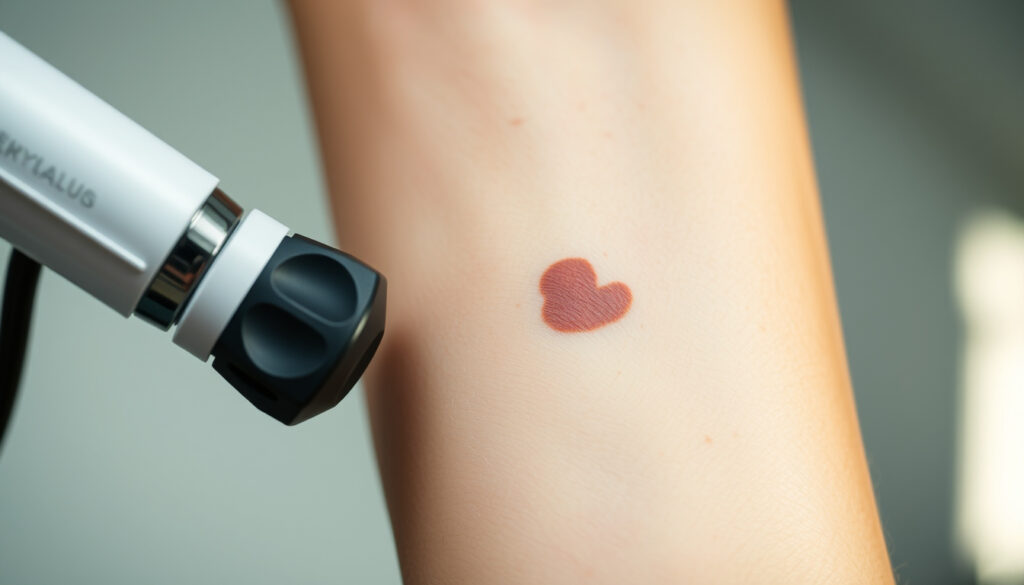
Early Stage Skin Cancer: Symptoms, Warning Signs & Pictures
That strange mole you have been eyeing in the mirror might be nothing — or it could be the earliest sign of skin cancer. The good news is that skin cancer is highly treatable when detected early, and knowing what to look for is the first step.
Most common cancer in the U.S.: Skin cancer is the most common cancer in the United States, with over 5 million cases diagnosed each year. ·
5-year survival for early melanoma: When detected early, the 5-year survival rate for melanoma is 99%. ·
Basal cell carcinoma share: Basal cell carcinoma accounts for about 80% of all skin cancers.
Quick snapshot
- UV exposure is the primary risk factor (The Skin Cancer Foundation)
- Basal cell carcinoma rarely spreads (Medical News Today)
- Melanoma can be fatal if not treated early (UT MD Anderson Cancer Center)
- Why some moles turn into melanoma while others do not
- Whether all actinic keratoses become squamous cell carcinoma
- Most early skin cancers take weeks to months to develop noticeable changes (The Skin Cancer Foundation)
- An open sore that does not heal within three weeks warrants a check (The Skin Cancer Foundation)
- Schedule a full skin exam with a dermatologist if you spot any new or changing lesion (American Cancer Society)
Four key figures sum up the landscape of early stage skin cancer.
| Metric | Value |
|---|---|
| U.S. annual cases | Over 5 million |
| Melanoma early survival rate | 99% (5-year) |
| Most common location | Face, neck, arms, hands |
| Primary cause | UV radiation from sun or tanning beds |
What do early forms of skin cancer look like?
Appearance of basal cell carcinoma
- A pearly or waxy bump that may have visible blood vessels (Medical News Today)
- A flat, flesh-colored or brown scar-like lesion
- A sore that bleeds, oozes, or crusts and does not heal
Medical News Today (health news outlet) notes that basal cell carcinoma can also appear as a pinkish patch on sun-exposed skin. It grows slowly and rarely spreads to other parts of the body.
A bump that seems trivial — like a pimple that never goes away — may be a basal cell carcinoma. Ignoring it gives it time to grow and become more difficult to treat.
Appearance of squamous cell carcinoma
- A firm, red nodule that may be scaly or crusty (Medical News Today)
- A flat sore with a scaly, crusted surface that may itch or bleed
- A growth that looks like a wart
Squamous cell carcinoma can develop on areas that receive chronic sun exposure, such as the rims of the ears, the lower lip, and the backs of the hands. While it is more likely to spread than basal cell carcinoma, early treatment yields excellent outcomes.
Appearance of melanoma
- A new spot or a change in an existing mole, often with irregular borders (Cleveland Clinic)
- A mole that shows multiple colors — shades of brown, black, blue, red, or white
- A small, pink, round bump that may catch on clothing (UT Southwestern Medical Center (academic medical center))
Melanoma can mimic harmless moles. The Cleveland Clinic (major hospital system) emphasizes that any spot that looks different from your other spots — the “ugly duckling” sign — should be checked.
How can I tell if I have skin cancer?
Performing a skin self-exam
The American Cancer Society (national cancer authority) recommends a simple routine after a bath or shower when lighting is good.
- Use a full-length mirror and a hand-held mirror to check all areas, including the scalp, back, and buttocks.
- Part your hair to examine the scalp, or use a blow-dryer to expose sections (The Skin Cancer Foundation (patient advocacy organization)).
- Check under the breasts, underarms, hands, fingers, thighs, shins, feet, toes, buttocks, genital area, lower and upper back, neck, and ears.
- Learn the pattern of your moles, blemishes, freckles, and other marks so that you can notice any changes later.
If you cannot see your back easily, ask a partner or friend for help. Also read our guide on skin cancer symptoms and self-exam guide for more detailed visuals.
Using the ABCDE rule for melanoma
The Cleveland Clinic (major hospital system) describes the ABCDE rule as a simple screening tool for melanoma:
- A — Asymmetry: one half does not match the other.
- B — Border: edges are ragged, notched, or blurred.
- C — Color: shades of black, brown, tan, white, gray, red, or blue appear in one spot.
- D — Diameter: larger than 6 mm (about the size of a pencil eraser).
- E — Evolving: the mole changes in size, shape, or color.
A mole presenting any of these features should be evaluated by a dermatologist. For a deeper dive, see our article on the ABCDE rule for melanoma detection.
When to see a dermatologist
- Any new, changing, or unusual spot, especially one that persists for more than two weeks (UT MD Anderson Cancer Center (top cancer center)).
- A sore that does not heal within three weeks (The Skin Cancer Foundation).
- A spot that bleeds, itches, or becomes painful.
Skin cancer often has no symptoms in its earliest stages (UT MD Anderson Cancer Center). Do not wait for pain or itching — rely on visual changes.
What are the 5 warning signs of skin cancer to look for?
A new growth or sore that doesn’t heal
- An open sore that bleeds, oozes, or crusts and persists for more than four weeks (Medical News Today).
Change in an existing mole
- Any mole that changes in size, shape, or color over weeks or months (Medical News Today).
A shiny or pearly bump
- A translucent, pearly, or waxy bump — a classic sign of basal cell carcinoma (Medical News Today).
A flat, scaly, reddish patch
- A pink or red scaly patch that may be mistaken for eczema or psoriasis — often an early squamous cell carcinoma (Medical News Today).
A black or brown streak under a nail
- A dark line or streak in a fingernail or toenail that is not due to injury can be acral lentiginous melanoma (The Skin Cancer Foundation).
The trade-off: Many of these signs overlap with benign conditions. A biopsy is the only way to confirm cancer.
Where do most skin cancers start?
Sun-exposed areas (face, ears, scalp, arms)
- The majority of skin cancers develop on the head, neck, arms, and hands — body parts that get the most direct sunlight (The Skin Cancer Foundation).
- Scalp skin cancer is especially common in men with thinning hair.
Less common sites (palms, soles, under nails)
- Melanoma can appear on skin that never sees the sun, such as the palms, soles, and under the nails (Medical News Today).
- These areas are often overlooked during self-exams.
The implication: Sun exposure matters most, but no area is completely immune. Check everywhere, not just the obvious spots.
How curable is skin cancer if caught early?
Cure rates for basal cell carcinoma
- Basal cell carcinoma is highly curable with early treatment; cure rates approach 100% (Medical News Today).
Cure rates for squamous cell carcinoma
- Squamous cell carcinoma is also very treatable when caught early, though it carries a higher risk of metastasis than BCC (Medical News Today).
Cure rates for melanoma
- Melanoma detected at stage 0 or 1 has a 5-year survival rate of 99% (The Skin Cancer Foundation).
The catch: Once melanoma spreads beyond the skin, the 5-year survival drops sharply to about 30%. Early detection is literally a life-or-death difference.
Confirmed facts vs. what remains unclear
Confirmed facts
- UV exposure is the primary risk factor for most skin cancers (The Skin Cancer Foundation).
- Basal cell carcinoma rarely metastasizes (Medical News Today).
- Melanoma can be fatal if not treated early (UT MD Anderson Cancer Center).
What’s unclear
- Exactly why some moles transform into melanoma while others do not.
- Whether all actinic keratoses progress to squamous cell carcinoma.
Expert perspectives
The ABCDE rule is a simple memory aid that can help you spot potential melanomas early, but it is not a substitute for a professional skin exam. If you notice any change in a mole, get it checked.
— Dr. Mark D. Kaufmann, dermatologist, Mayo Clinic (academic medical center)
Monthly self-exams combined with an annual professional skin exam give patients the best chance of catching skin cancer at its most treatable stage. Knowing your own skin is your best defense.
— American Academy of Dermatology (professional dermatology society) spokesperson
For a person who notices a new or changing spot, the choice is clear: schedule a dermatologist appointment now, or risk a much more serious diagnosis later. Early detection is not just about survival — it often means simpler, less invasive treatment.
For a detailed overview of warning signs across different skin cancer types, see this guide on symptoms of skin cancer.
Frequently asked questions
Can skin cancer appear as a scab that doesn’t heal?
Yes. A sore that bleeds, crusts, or scabs and does not heal within three to four weeks is a classic warning sign, especially for basal cell and squamous cell carcinoma (The Skin Cancer Foundation).
Is it normal for a mole to change color?
No. A mole that changes color — especially if it becomes multicolored with shades of brown, black, blue, or red — should be evaluated by a dermatologist (Cleveland Clinic).
How often should I do a skin self-exam?
The American Cancer Society recommends a self-exam once a month, and an annual professional skin exam from a dermatologist.
Are all skin cancers caused by sun exposure?
No. While UV radiation is the primary cause, melanoma can develop on parts of the body that rarely see the sun, such as the palms, soles, and under nails (Medical News Today).
What is the ABCDE rule for melanoma?
The ABCDE rule is a guide for spotting melanoma: Asymmetry, Border irregularity, Color variation, Diameter larger than 6 mm, and Evolution (change over time) (Cleveland Clinic).
Do skin cancers itch or hurt?
Early stage skin cancer often has no sensation at all. UT MD Anderson Cancer Center notes that most early skin cancers are asymptomatic (UT MD Anderson Cancer Center).
Can skin cancer develop on skin that is never exposed to the sun?
Yes. Some melanomas arise on areas like the palms, soles, under nails, and mucous membranes (The Skin Cancer Foundation).
More related posts
 Mitchell Moses: Biography, Family, Salary, Injury News
 FIFA Club World Cup Brackets – 2025 Full Draw Results
 Kate Mara: Career, Family, and Elliot Page Revelations
 Leigh Matthews: AFL Legend, Coach, and 1985 Conviction
 St George Hospital – Guide to Location, Services and Contact
 Best Home Insurance – Top Companies Rates Reviews
 Drop Dead Fred – Plot, Cast, Where to Watch & Ending Explained
