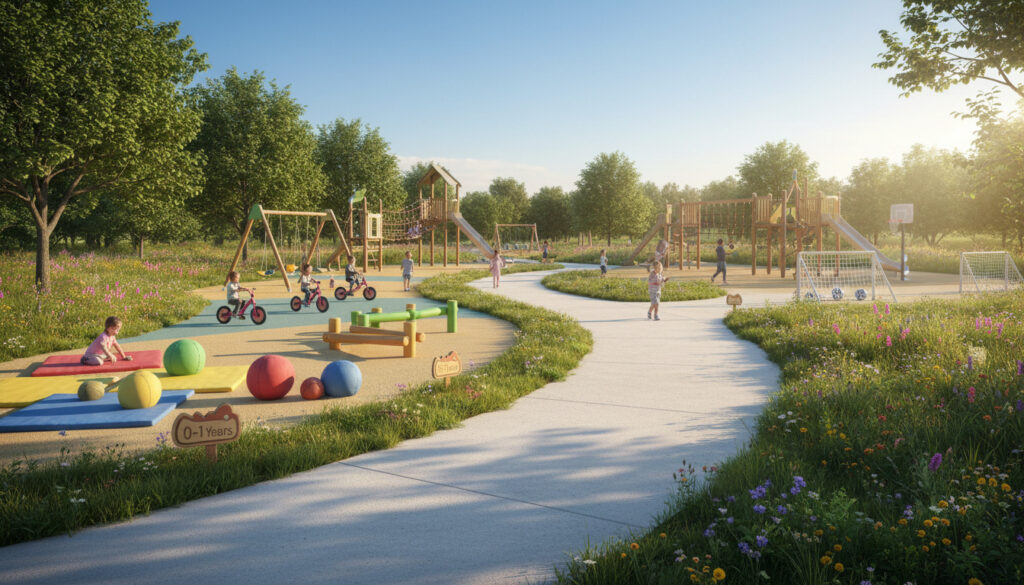
Gross Motor Skills – Age-by-Age Milestones Guide
Gross motor skills encompass the coordinated movements of large muscle groups throughout the arms, legs, and torso that enable children to walk, run, jump, and climb. These foundational physical capabilities emerge during infancy and continue refining through early childhood, supporting not only mobility but also the development of body awareness, balance, strength, and reaction speed, according to Children’s Hospital of Richmond.
Unlike the precise finger movements required for drawing or buttoning shirts, gross motor activities engage the entire body in dynamic motion. Cleveland Clinic specialists note that children rely on these skills for everyday tasks ranging from lifting objects and kicking balls to navigating playground equipment and maintaining stability during physical play.
Developmental timelines vary considerably among healthy children, with genetics, environment, and daily opportunities all influencing when specific milestones appear. While most youngsters follow a predictable progression from head control to walking to complex athletic movements, individual paths differ in both timing and style, and variation within established ranges typically represents normal development.
What Are Gross Motor Skills?
Large muscle movements enabling whole-body coordination such as walking, jumping, and throwing
Crawling, running, balancing on one foot, climbing stairs, and catching balls
Physical health foundation, spatial coordination, and confidence building for social play
Development begins at birth and continues refining through age 6 and beyond
- Skills progress sequentially from head control downward through the body
- Large muscle strength provides the foundation for later fine motor precision
- Each milestone requires integration of balance, coordination, and muscular strength
- Individual timing varies widely within normal developmental windows
- Regular physical activity supports healthy weight and cardiovascular development
- Mastery of gross movements correlates with cognitive and social readiness for school
| Age | Key Milestone | Example Activity |
|---|---|---|
| 0-2 months | Head lifting, side-to-side turning | Supervised tummy time on flat surfaces |
| 3-4 months | Rolling belly-to-back, forearm pushing | Reaching for toys during tummy play |
| 5-6 months | Back-to-belly rolling, pivoting | Bringing feet to mouth while supine |
| 6-8 months | Independent sitting, belly crawling | Reaching for toys while seated |
| 9-11 months | Hands-and-knees crawling, cruising | Moving along furniture while standing |
| 12-14 months | Independent walking, squatting | Carrying objects while walking |
| 15-18 months | Running (with falls), stair climbing with help | Kicking balls forward |
| 2 years | Jumping in place, stair walking alone | Walking up steps without support |
| 3 years | Balancing briefly on one foot, tricycle riding | Alternating feet on stairs |
| 4 years | Hopping, skipping, catching reliably | Hopscotch and somersaults |
| 5 years | Skipping rope, swimming, bike riding | Using playground equipment independently |
| 6+ years | Predictable throwing/catching, balance beams | Organized sports and gymnastics |
Gross Motor Skills Milestones by Age
The progression of gross motor development follows a cephalocaudal pattern, meaning control develops from the head downward through the trunk and legs. Lurie Children’s Hospital physical therapy specialists emphasize that while specific ages provide reference points, healthy children may achieve these markers several months earlier or later without indicating underlying problems.
0 to 6 Months: Foundations of Movement
Newborns display reflexive movements that quickly give way to voluntary control. By two months, infants typically lift their heads 90 degrees during tummy time and turn heads side-to-side while supine. Between three and four months, babies push up onto forearms and execute the first roll from belly to back. By five months, many pivot in circles on their stomachs and roll back-to-belly, while six-month-olds often sit independently and begin belly crawling.
6 to 12 Months: Mobility and Exploration
The second half of the first year brings dramatic changes in independence. Infants transition from sitting to crawling on hands-and-knees, then progress to pulling to stand and cruising along furniture. Brown Health developmental specialists note that most children take independent steps between 12 and 14 months, though normal variation extends from 9 to 18 months.
1 to 2 Years: Walking, Running, and Climbing
Toddlers refine their gait from tentative stepping to confident walking and running, though falls remain common through 18 months. NAPA Center therapists document that two-year-olds typically jump in place with both feet, kick balls with either foot, and navigate stairs alone, marking the transition from infancy to early childhood mobility.
3 to 5 Years: Coordination and Sport Readiness
Preschoolers develop the balance and strength required for alternating feet on stairs, riding tricycles, and hopping on one foot. By age four, children skip proficiently and catch bounced balls reliably. Five-year-olds often skip rope, skate, swim, and ride bicycles with or without training wheels, demonstrating the integration of multiple muscle groups for complex athletic movements.
Starting from the first weeks of life, supervised tummy time while awake builds the neck and shoulder strength necessary for later crawling and sitting. Parents should increase duration gradually as tolerance develops, placing toys at eye level to encourage lifting and reaching.
Activities and Exercises to Develop Gross Motor Skills
Structured and unstructured play provides the sensory and muscular stimulation required for motor development. Oxford Health pediatric resources recommend incorporating movement into daily routines rather than treating exercise as a separate activity.
For Infants and Babies
Pull-to-sit exercises strengthen neck flexors while familiarizing babies with upright positioning. Rolling practice across soft surfaces promotes trunk rotation, while encouraging crawling through tunnel toys develops coordination. Lurie Children’s specialists recommend placing toys just out of reach during tummy time to motivate pivoting and crawling attempts.
For Toddlers and Preschoolers
Indoor obstacle courses using cushions and boxes develop spatial awareness and climbing confidence. Dancing to music improves rhythm and balance, while ball play enhances hand-eye coordination. For parents seeking dedicated environments for active play, Funtopia Carrum Downs – Hours, Prices, Activities Guide offers structured climbing and play facilities designed specifically for developing motor skills in children.
Outdoor and Advanced Activities
Playground equipment provides opportunities for sliding, swinging, and climbing that challenge balance and strength simultaneously. Crane Schools physical education guidelines suggest that four-year-olds benefit from line walking, overhead throwing, and independent slide use. Swimming, skating, and organized sports introduced around age five refine the timing and coordination developed during earlier years.
Gross Motor Skills vs. Fine Motor Skills: Key Differences
The distinction between these motor categories lies primarily in muscle group size and movement precision. Gross motor skills utilize large muscles for whole-body actions such as standing, running, and jumping, while fine motor skills engage small hand and wrist muscles for precise tasks like grasping blocks, using pincer grasps, and manipulating utensils.
| Age Group | Gross Motor Examples | Fine Motor Examples |
|---|---|---|
| 3-5 months | Lifts head, rolls belly to back | Grasps string or block, reaches for toys |
| 6-8 months | Sits independently, crawls | Transfers objects between hands |
| 9-11 months | Cruises furniture, stands briefly | Claps hands, pincer grasp, removes socks |
| 12-14 months | Walks independently | Pincer grasp, uses spoon, pegboard play |
| 2-3 years | Jumps, rides tricycle | Stacks 8-10 cubes, draws circles, uses fork |
Gross motor proficiency establishes the postural stability and shoulder strength necessary for fine motor development. Children require adequate trunk control to sit upright at desks before they can effectively manipulate pencils or scissors.
Forcing fine motor tasks before gross motor foundations are secure may result in compensatory patterns or frustration. Children develop according to their own neurological readiness, with large muscle control preceding small precision movements.
At What Age Do Children Develop Gross Motor Skills?
Motor development unfolds in predictable sequences, though the exact timing depends on individual growth patterns, physical opportunities, and neurological maturation. The following timeline represents typical achievement windows based on pediatric developmental research.
- Birth to 2 months: Lifts head briefly during tummy time; turns head side-to-side while supine
- 3-4 months: Rolls from belly to back; pushes up onto forearms
- 5-6 months: Rolls back to belly; pivots on stomach; sits with support
- 6-8 months: Sits independently; crawls on belly; pulls to standing
- 9-11 months: Crawls on hands and knees; cruises along furniture; walks with two hands held
- 12-14 months: Takes independent steps; squats and stands without support
- 15-18 months: Walks up stairs with help; runs with frequent falls; kicks balls
- 2 years: Jumps in place; walks stairs alone; kicks with either foot
- 3 years: Balances on one foot briefly; rides tricycle; alternates feet on stairs
- 4 years: Hops on one foot; catches balls reliably; skips
- 5 years: Skips rope; rides bicycle; swims and skates
Signs of Gross Motor Skills Delay and When to Seek Help
Distinguishing between normal variation and genuine delays requires understanding established developmental markers while recognizing that rigid timelines do not account for individual differences. The following framework separates confirmed warning signs from areas where uncertainty remains.
- Persistent head lag beyond 4 months when pulled to sit
- No rolling in either direction by 6 months
- Inability to sit independently by 8 months
- No independent walking by 18 months
- Frequent falling or inability to jump by age 3
- Exact month when walking begins (normal range: 9-18 months)
- Preference for bum-shuffling versus crawling
- Temporary regression during illness or stress
- Impact of birth order or childcare settings on practice time
Cleveland Clinic pediatricians recommend consulting healthcare providers when children miss multiple milestones or display asymmetrical movement patterns, such as favoring one side of the body. Early intervention services can address underlying neuromuscular or orthopedic conditions effectively when identified promptly.
Why Are Gross Motor Skills Important?
Beyond obvious physical benefits, gross motor development correlates with cognitive advancement and social competence. Children who master body control demonstrate improved attention spans for classroom learning, as the same neurological pathways govern both movement and executive function. Physical confidence acquired through climbing, running, and balancing translates into willingness to attempt new academic challenges and social interactions.
Regular engagement in large-muscle activities establishes lifelong patterns of physical fitness while preventing childhood obesity. The strength and endurance developed through active play support cardiovascular health and bone density. For parents modeling active lifestyles, selecting appropriate footwear like the Asics GT 1000 12 – Complete Review and Buying Guide can support family walking and running activities that encourage children’s participation in sustained physical exercise.
Expert Perspectives on Motor Development
Leading pediatric institutions emphasize the interaction between biological readiness and environmental opportunity in shaping motor outcomes.
“Gross motor skills form the foundation for fine motor skills, body awareness, balance, strength, and reaction speed. These skills enable everyday physical tasks and support overall developmental progress.”
Children’s Hospital of Richmond Therapy Services
“Children develop at individual rates; consult a provider if concerned. Regular monitoring of milestones helps identify children who may benefit from early intervention services.”
Cleveland Clinic Pediatric Specialists
Supporting Your Child’s Physical Development
Monitoring milestone progression while providing safe opportunities for movement represents the most effective approach to supporting gross motor development. Parents should observe children’s play patterns, encourage outdoor exploration, and consult pediatricians when delays persist beyond normal variation. Trusted resources including the Funtopia Carrum Downs – Hours, Prices, Activities Guide offer venues specifically designed to challenge developing motor skills in engaging, age-appropriate environments.
Frequently Asked Questions
Can gross motor skills improve with practice?
Yes, regular physical activity strengthens muscles and refines coordination. Daily play, climbing, and running provide natural practice that enhances skill proficiency.
Are gross motor delays permanent?
Not necessarily. Early intervention through physical therapy often addresses delays effectively. The brain remains adaptable during early childhood, allowing for significant improvement with targeted support.
How much daily activity do toddlers need?
Health organizations recommend at least three hours of physical activity spread throughout the day for children under five, including both light and vigorous movement.
Do premature babies reach milestones later?
Premature infants often reach milestones according to their adjusted age (due date rather than birth date) during the first two years. Healthcare providers track progress using corrected gestational age.
Does screen time affect gross motor development?
Excessive screen time indirectly delays motor skills by displacing active play. Children sitting for extended periods miss opportunities to build strength and coordination through physical movement.
What surfaces are best for learning walkers?
Barefoot walking on firm, flat surfaces allows optimal proprioception and balance development. Avoid overly soft or uneven terrain during early walking stages.
More related posts
 Chrishell Stause: Biography, Relationships and Net Worth
 Brendan Fraser Health Condition & What Happened to His Career
 184 cm in Feet: Exact Conversion, Height Comparison & More
 Lukas Gage: Actor, Net Worth, The White Lotus, and Personal Life
 Avengers: Age of Ultron: Hit, Flop or Fan Divide?
 John Wayne: Death, Life, Legacy – Separating Myth from Fact
 Chris Scott: Allegations, Tragedy, and Multiple Identities
 George Carlin: Life, Net Worth, and the Seven Dirty Words Case
