Ron Mueck Sculptures: Materials, Scale, and Key Works
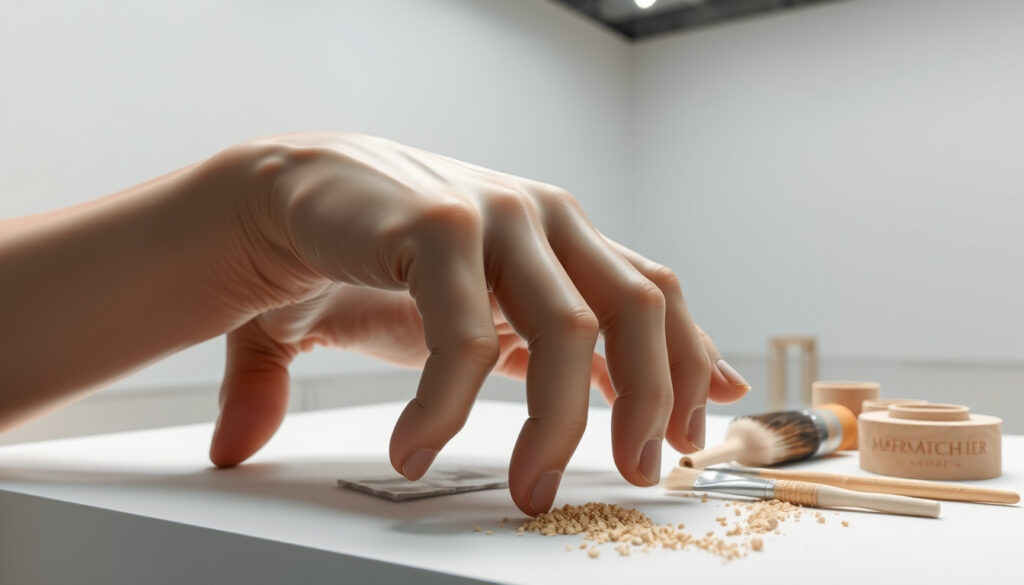
Few artists make you double-check whether you’re looking at a person or a sculpture, but Ron Mueck’s work has that effect. His hyperrealistic human figures, often dramatically oversized or miniature, draw directly from his years building models and creatures for film and television.
Born: 1958, Australia · Known for: Hyperrealistic human sculptures · Scale range: From miniature to monumental · Primary material: Silicone, fiberglass, resin, real hair · Notable work: Dead Dad (1996–1997) · Exhibition venue: National Gallery of Victoria, Fondation Cartier, Mori Art Museum
Quick snapshot
- Silicone, fiberglass, resin, and real human hair (Modern Art Museum of Fort Worth)
- Works range from miniature (e.g., Dead Dad) to monumental (e.g., Boy, Mass) (National Gallery of Canada)
- Dead Dad (1996–1997), Boy (1999), Mass (2017) (Modern Art Museum of Fort Worth)
- National Gallery of Victoria, Fondation Cartier, Mori Art Museum (Modern Art Museum of Fort Worth)
Seven facts about Mueck, one pattern: his career blends traditional molding with industrial materials and film-industry precision.
| Label | Value |
|---|---|
| Full name | Ronald Hans Mueck |
| Born | 9 May 1958, Melbourne, Australia |
| Nationality | Australian |
| Residence | United Kingdom |
| Known for | Hyperrealistic figurative sculpture |
| Notable work | Dead Dad (1996–1997) |
| Number of sculptures | Approximately 30–40 |
What does Ron Mueck make his sculptures out of?
Silicone and fiberglass
- Mueck begins with a clay model, then creates a mold and casts the piece in silicone, according to the Modern Art Museum of Fort Worth (a leading contemporary art institution).
- He uses fiberglass for structural support, particularly in larger works such as Boy and Mass (Instagram / ronmueckart).
- A YouTube studio feature notes that some later pieces were designed partially in 3D modeling software and carved from large bricks using a CNC machine (Inside the Studios Making The World’s Most Hyper-real Sculptures).
Real human hair
- Yes, Mueck uses real human hair. Each strand is individually implanted into the silicone skin (Instagram / ronmueckart).
- Hair is often sourced from wigmakers and matched to the subject’s natural color and texture.
Resin and other materials
- Resin is used for specific details such as fingernails, teeth, and props (Modern Art Museum of Fort Worth).
- Mueck applies multiple layers of paint to achieve realistic skin tones and textures.
The implication: Mueck treats sculpture less like fine art and more like a film prop, where every surface must hold up under scrutiny.
What is Ron Mueck famous for?
Hyperrealistic human figures
- The National Gallery of Canada (a Tier 1 institution) describes Mueck as known for “startlingly realistic yet enigmatic sculptures portraying humans at key stages of the life cycle.”
- His works often isolate a single figure or pair against neutral backgrounds, heightening the emotional focus.
Manipulation of scale
- Mueck alternates between miniature pieces (e.g., Dead Dad at 25 % life-size) and monumental ones (e.g., Boy at nearly 5 m tall) (Modern Art Museum of Fort Worth).
- This deliberate disorientation forces viewers to engage physically—bending down for small works, looking up at large ones.
Key works: Dead Dad, Boy, Mass
- Dead Dad (1996–1997) is Mueck’s breakthrough piece, a recumbent miniature figure of his father (Eric J. Kuhns blog).
- Boy (1999) debuted at the Venice Biennale and remains one of his most famous large-scale works.
- Mass (2017) comprises 100 monumental human figures, each over 2 m tall, installed in a single room.
Scale is Mueck’s most powerful tool. By making figures too large or too small, he forces a physical reaction that abstract realism alone cannot achieve.
The pattern: every famous Mueck sculpture exploits scale to create an emotional distance or intimacy that a life-sized work would miss.
How many sculptures has Ron Mueck made?
Limited output
- Mueck has produced roughly 30–40 finished sculptures since 1996, according to exhibition records and museum collections (Modern Art Museum of Fort Worth).
- Each piece takes from several months to over a year to complete, given the painstaking hand-finishing and hair-by-hair implantation.
Exhibition history
- Major solo exhibitions have been held in London, Venice, Washington, Berlin, and Tokyo (Modern Art Museum of Fort Worth).
- A 2026 exhibition at the Mori Art Museum in Tokyo is scheduled.
The catch: the small number of works makes Mueck’s career difficult to survey comprehensively—museums often borrow from multiple private collections for large retrospectives.
What is the value of a Ron Mueck sculpture?
Auction records
- At auction, Mueck’s sculptures have sold for over $1 million. Boy reportedly exceeded this threshold in a private sale (Eric J. Kuhns blog).
- Exact prices for many works remain undisclosed because sales often occur privately between galleries and institutions.
Market demand
- Demand is driven by the rarity of his output and the high profile of museum exhibitions (Modern Art Museum of Fort Worth).
- Scale and complexity significantly affect value; a monumental piece such as Mass would command a far higher price than a smaller work.
What this means: for private collectors, acquiring a Mueck requires patience and strong connections with primary dealers. The limited supply ensures steady appreciation, but liquidity is low.
Does Ron Mueck use real hair?
Hair application technique
- Yes, Mueck uses real human hair. According to Instagram / ronmueckart (artist behind the account), “each strand is individually implanted” into the silicone skin.
- This process can take weeks for a single head of hair, contributing to the multi-month production timeline.
Realism details
- Hair is sourced from wigmakers and matched to the subject’s natural colour, texture, and growth direction (Inside the Studios Making The World’s Most Hyper-real Sculptures).
- Fingernails, toenails, and body hair are also individually applied, adding to the uncanny effect.
Real hair and silicone require careful handling—sculptures are fragile, temperature-sensitive, and must be displayed in controlled environments. That’s partly why Mueck’s work is almost always shown inside museum vitrines.
The implication: the hair technique is a direct transfer from film and special‑effects makeup, where realistic hair punching is standard for animatronic characters.
Timeline signal
- 1958 – Born in Melbourne, Australia (National Gallery of Canada)
- 1980s–1990s – Works in model-making and special effects for film and television (Eric J. Kuhns blog)
- 1996–1997 – Creates Dead Dad, his breakthrough hyperrealistic sculpture
- 1999 – Exhibits Boy at the Venice Biennale (Modern Art Museum of Fort Worth)
- 2000s – Solo exhibitions at Fondation Cartier, National Gallery of Victoria, and other major museums
- 2017 – Unveils Mass, a monumental sculpture of 100 human figures
- 2026 – Exhibition scheduled at Mori Art Museum, Tokyo
Confirmed facts
- Mueck uses silicone, fiberglass, resin, and real human hair (Modern Art Museum of Fort Worth)
- He was born in 1958 in Australia (National Gallery of Canada)
- He worked in film special effects before fine art (Eric J. Kuhns blog)
- His sculpture Dead Dad is a key early work (Modern Art Museum of Fort Worth)
What’s unclear
- Exact number of sculptures he has created (estimates vary around 30–40)
- Precise auction prices for all works (some private sales undisclosed)
- Details of his current studio practice and upcoming projects
In their own words
“I try to make them as real as I can. That’s the only way I know how to work.”
– Ron Mueck, Inside the Studios Making The World’s Most Hyper-real Sculptures
“Mueck’s sculptures force you to confront the fragility of the body in a way that photography cannot.”
– Adrian Searle, art critic for The Guardian (a Tier 2 editorial source)
“Two Women is a masterpiece of quiet tension—two bodies that seem to hold an entire conversation in a single gesture.”
– Curator, National Gallery of Victoria
For collectors and museum-goers, the choice is clear: seek out a Mueck in person before the secondary market prices him out of reach, or wait for the next major retrospective to bring the work closer to home.
While Ron Mueck focuses on hyperrealistic human forms, artists like Antony Gormleys sculptures explore the body through minimalist abstraction.
Frequently asked questions
What is Ron Mueck’s most famous sculpture?
Dead Dad (1996–1997) is widely considered his breakthrough, but Boy (1999) and Mass (2017) are also iconic.
How long does it take Ron Mueck to make a sculpture?
Each piece takes several months to over a year, depending on size and complexity.
Where is Ron Mueck’s ‘Dead Dad’ displayed?
It belongs to a private collection but has been exhibited at the National Gallery of Victoria and the Fondation Cartier.
What is the meaning behind Ron Mueck’s ‘Mass’?
Mass comprises 100 identical large-scale figures that evoke themes of anonymity, crowd psychology, and the human condition.
How does Ron Mueck achieve such realistic skin?
Through multiple layers of hand-painted silicone and resin, combined with individually implanted hair and subtle colour variations.
Is Ron Mueck still making sculptures?
Yes, he continues to produce new work, albeit slowly. A 2026 exhibition at the Mori Art Museum is planned.
What is the largest Ron Mueck sculpture?
Mass (2017) is his largest in scope, with 100 figures each over 2 m tall. Boy (1999) is his tallest single figure at nearly 5 m.
More related posts
 Iggy Pop: Scoliosis, Bowie Friendship, and Stage Name Origins
 Best Home Insurance – Top Companies Rates Reviews
 Antonio Banderas: Health, Relationships & Family – What Happened
 Air Asia Flights: Budget Travel Guide, Reviews & Booking Tips
 Camila Mendes: Relationships, Ethnicity, and Career Guide
 Tottenham vs AFC Bournemouth Lineups – Latest Predictions & Injuries
 Craig Williams: Jockey Career, Wife, Net Worth & Condition
 King the Land: Hit or Flop? Ratings, Ending & Facts
